Categories
animal welfare compassion cruelty Dairy ethics Food and Drink News/Blog plant-based diet Promoted vegan vegetarianism

Abbotsford pig farm cruelty: Another example of why animal agriculture can’t be trusted

Photo: PETA


Yesterday’s release of an undercover video showing sick and dying pigs living in filthy conditions at the Excelsior Hog Farm in Abbotsford is just the latest example of why the animal agriculture industry cannot be trusted to raise animals humanely.

Pigs at the farm, which is owned by a director of the BC Pork Producers Association, are shown in the video unable to stand, some with large untreated growths on their bodies. Dead piglets and an adult dead pig can also be seen.

In 2014, animal activists released video that exposed horrific cruelty inflicted on cows at Chilliwack Cattle Sales, Canada’s largest dairy farm.  At the time, Jeff Kooyman, one of the owners of the farm, said he was “shocked” and claimed he had no idea his staff were allegedly abusing the cows. In 2016, Kooyman and five members of his family were charged with causing or permitting animals to be, or to continue to be, in distress – a violation of B.C.’s Prevention of Cruelty to Animals Act. Several company employees were also charged under the act and later jailed.  The company was fined $300,000.

In June 2017, video footage released by animal activists showed chickens at a Chilliwack poultry operation being mangled, stomped on, thrown against a wall, and smashed into transport crates. The BC SPCA, which described the abuse as “absolutely sickening,” recommended charges, but nearly two years later Crown Counsel has still not prosecuted anyone. (In December 2018, the Canadian Food Inspection Agency (CFIA) laid charges under federal Health of Animals Regulation against Sofina Foods, Elite Farm Services and Elite’s president, Dwayne Dueck, for allegedly beating chickens and loading them in a way “likely to cause injury or undue suffering.”)

In 2018, the BC SPCA announced it was again investigating Elite Farm Services and a chicken farm called Jaedel Enterprises in what it said was “another situation where chickens have allegedly suffered as a result of what appears to be a blatant disregard to adherence of the industry’s own agreed-upon standards of care and a failure to either comply with or put in place processes to ensure this type of suffering does not occur.”

The poultry, dairy and pork industries responsible for the care of these animals routinely deny that these horrific cases of abuse are “the norm.” It’s always just a few “bad apples” they say, while expecting the public to believe that all the other animals on Canadian farms are living happy lives in wonderful conditions. 

But these undercover animal cruelty cases, and the many others that have exposed similar abuse across Canada, the United States and elsewhere, should make clear that modern industrial agriculture can never provide humane conditions for animals.

Many Canadians do not realize that animal farmers in Canada largely police themselves. There are Codes of Practice to protect animal welfare on Canadian farms but there are no government inspections to enforce the codes in terms of conditions on farms. Government oversight only extends to animal transportation and slaughter practices, not the living conditions or overall well-being of animals farmed for food.

Vancouver Humane believes that it is impossible to give animals a good life on modern, industrialized farms. The system is designed to provide cheap meat, dairy and eggs, not to ensure good animal welfare.

Animals are sentient beings that deserve to be treated with respect and kindness. That’s not going to happen on factory farms, where more than 90 per cent of Canada’s farm animals are raised.

That’s why we encourage people to switch to a plant-based diet and refrain from consuming animal-based products. That’s why we support the rise of plant-based businesses and call on governments at all levels to do the same. 

Modern animal agriculture will never be good for animals and it has been shown to be bad for the environment and for our health.  It’s time to build a food system that is healthy, sustainable and compassionate.


Categories
animal welfare compassion cruelty Cruelty-free Dairy Donate ethics News/Blog plant-based diet Promoted vegan vegetarianism wildlife

Why is a humane society talking about plant-based diets?

“Put simply, when we eat animal products we hurt both farmed and wild animals”


Anyone who is familiar with Vancouver Humane’s work or follows our social media channels will notice that we encourage people to try a plant-based diet. Some people, especially those who see a humane society’s work as limited to helping companion animals, might wonder why we put such emphasis on changing diets.

The most obvious reason is that the fewer meat and dairy products we consume, the fewer animals need to be slaughtered. Another reason is that reducing animal-based food consumption negates the case made by industry for factory farming, which exists because of the demand for intensively-produced, cheap meat and dairy.  In short, eating fewer animal products means less slaughter and suffering. It’s also worth noting that 60 per cent of all mammals on earth are livestock, so addressing factory farming means helping large numbers of animals.

“There is substantial evidence that meat consumption contributes to global warming” 

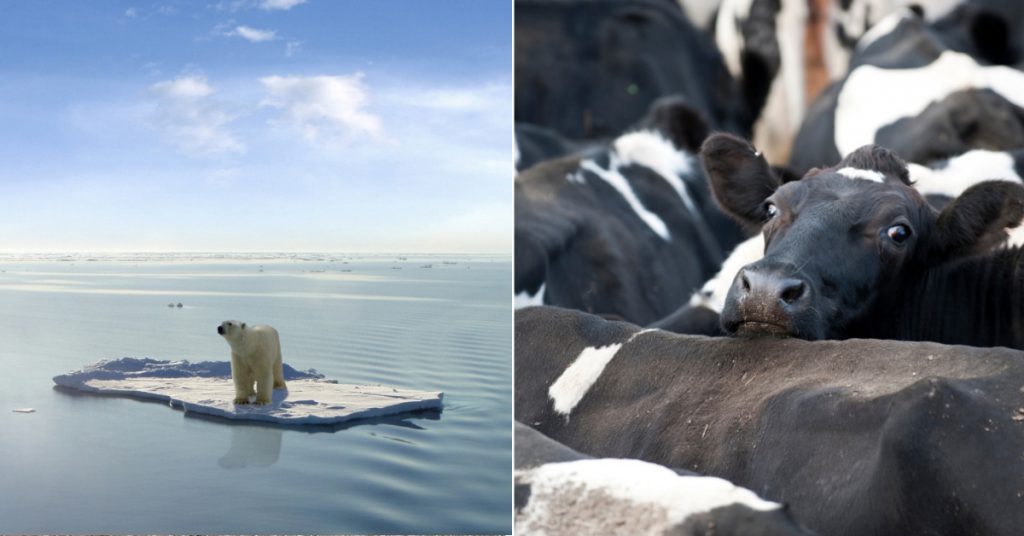
But cutting meat consumption benefits animals in other important ways. Most people are now aware of the threat of climate change to the planet – and that means a threat to animals as well as humans. There is substantial evidence that meat consumption contributes to global warming. (The United Nations says that the livestock sector produces 14.5 per cent of human-generated global greenhouse gas emissions.) And there is no doubt climate change is having an impact on wildlife. As the WWF says, “From polar bears in the Arctic to marine turtles off the coast of Africa, our planet’s diversity of life is at risk from the changing climate.”

Aside from contributing to the harm to wildlife through global warming, meat consumption is having a negative impact on animals by causing other environmental damage. A 2017 WWF study found that excessive animal product consumption is responsible for 60 per cent of all biodiversity loss, due to the massive amount of land being used to grow feed for livestock. A previous study on biodiversity loss concluded that: “The consumption of animal-sourced food products by humans is one of the most powerful negative forces affecting the conservation of terrestrial ecosystems and biological diversity. Livestock production is the single largest driver of habitat loss, and both livestock and feedstock production are increasing in developing tropical countries where the majority of biological diversity resides.”  Put simply, when we eat animal products we hurt both farmed and wild animals.

“Livestock production is the single largest driver of habitat loss”

Our focus on reducing the consumption of animal products doesn’t mean we don’t also work to improve the lives of animals currently suffering on factory farms.  We publicly demand accountability for incidents of deliberate animal cruelty on farms and we routinely push for better conditions for farmed animals through, for example, government consultations.

We also make time to address other issues such as rodeos, animals in captivity and the plight of animals whose welfare is often overlooked.

And we haven’t forgotten our precious companion animals, who we help through our McVitie Fund when they are sick and injured.

It’s your donations that make all this work possible. Whether you want to make a better future for animals or help them right here and now, your support will make a real difference.

Take action: Our Go Veg campaign
News: Our latest article on the Daily Hive 

Categories
animal welfare compassion cruelty Cruelty-free Dairy News/Blog plant-based diet Promoted vegan vegetarianism

Move to incorporate farmed animal codes into law will not protect animals from cruelty

The provincial government recently announced it will be adopting into law the codes of practice for the care and handling of farm animals, as outlined by the National Farm Animal Care Council (NFACC).

The NFACC codes provide guidelines for animal handling, feed and water, housing and health, among other things. They will come into effect for poultry, fur and meat farmers across the province in June of this year.

While on the surface this may seem like a good thing for animals, the devil is in the details. NFACC is largely made of up industry representatives – it includes farmers, producers, transporters, veterinarians, retail and food service organizations, processors, governments and researchers, and animal welfare and enforcement agencies.

The Vancouver Humane Society (VHS) has several concerns about the adoption of the codes of practice into B.C. law. First, the adoption of the codes will not eliminate inherently inhumane practices currently applied to animals confined on farms. For instance, dairy cows will still spend most, if not all, of their lives indoors and be separated from their newborn calves; chickens will still be selectively bred for crippling fast growth; pigs will still be confined in crates. These are all still permissible under the codes of practice.

Second, how the codes are implemented into provincial law is of crucial importance. Animal Rights Lawyer, Anna Pippus, wrote about this in detail in 2016, after B.C. incorporated the codes of practice for dairy cattle into law. While the government celebrated it as a step forward in improving the welfare of dairy cows in B.C., Pippus noted that the dairy codes were incorporated as a defence rather than as a requirement. The BC Dairy Cattle Regulation recognizes the dairy code practices “as reasonable and generally accepted practices of dairy farming for the purposes of section 24.02 (c) of the Act”, instead of incorporating them as requirements that farmers must comply with. For comparison, Prince Edward Island’s animal welfare regulations reference the codes of practice as follows – “Every owner of a commercial animal shall comply with the codes of practice listed in Schedule B in respect of the commercial animal to which the code applies.”

This mean that in B.C., if a dairy farmer was accused of causing distress to an animal they could avoid charges by arguing that they were complying with the “reasonable and generally accepted practices of dairy farming.” Yet, the same regulation does not allow for farmers to be prosecuted if they aren’t complying with the codes, due to the fact that the dairy codes were not incorporated into law as a requirement that farmers must meet.

Fast forward to 2019, and we’re seeing this story repeat itself, with the remaining farm animal codes of practice being incorporated into B.C. law under the headline of improving animal welfare, but seemingly with the same problematic implications – as reasonable and generally acceptable livestock management practices, thus offering a defence for farmers, not animals.  

Join us in telling the provincial Minister of Agriculture Lana Popham that incorporating the NFACC codes of practice for farm animals as a defence for farmers is a step in the wrong direction. If we are to truly advance the welfare of farmed animals, on-farm regulations should be based on the best available science (not the industry-led codes of practice) and government oversight in the form of pro-active, on-farm audits in order to ensure compliance. See below for key points to make in your email to the Minister.

Ultimately, the best thing that we as individual consumers can do to truly protect animals from cruelty is to not eat, wear or use them. Today there are more alternatives to animal products on the market than ever before, making it easier for people to choose products that align more closely with their values.

Key points:

  • While the adoption of the codes into B.C. law is being framed by the government as strengthening animal welfare, it actually does nothing to further animal welfare. The codes still permit inhumane practices including selective breeding for crippling fast growth, separation of mothers from young and intensive confinement. 
  • Implementing the codes of practice as “reasonable and generally acceptable livestock management practices” and not as requirements that farmers must meet protects farmers, not the animals.
  • To truly advance farmed animal welfare, on-farm regulations should be based on the best available science, not industry-led codes of practice. The regulations should also be subject to government oversight through pro-active, on-farm inspections.
Categories
animal welfare compassion Food and Drink News/Blog plant-based diet Promoted school Uncategorized

Students lead the effort to create a better world

Students are saving the world. Just skim the news lately and you’ll come across headlines about 16-year-old Swedish activist Greta Thunberg’s compelling call to action at the recent UN Climate Change talks, or about the growing #FridaysForFuture youth movement and the recent Youth Climate Strike. Globally, youth are mobilizing a mass movement focused on creating a better world.

Locally, we at the Vancouver Humane Society are also inspired by the youth who have led the effort to bring more humane, healthy and sustainable plant-based foods to their school menus and who have worked to educate and empower their peers, and are proud to support amazing young people in Metro Vancouver.

Shiqi Xu and Naiara Peruchena are two of those local students who have been inspiring change in their community. Our Program Coordinator, Emily Pickett, first met Shiqi and Naiara in 2016 and supported them in co-founding a Meatless Monday Club at their school, Sutherland Secondary, helping to promote plant-based menu changes in order to help animals. Since 2016, their club has led a highly successful Meatless Monday campaign, with the growing demand for plant-based menu items leading to their school’s food service provider to commit to transitioning 20 percent of the daily menu to plant-based foods!

Shiqi and Naiara also presented their Meatless Monday work to the North Vancouver School Board, asking for a letter of support, which the board enthusiastically provided. They were also successful in getting a student choice policy for animal dissection implemented in the school district, with support from the Animals in Science Policy Institute. The student choice policy allows students to opt out of animal dissection and participate in alternative learning methods.

Sutherland Secondary students Naiara Peruchena (on left) and Shiqi Xu (on right)

All that said, it came as no surprise to us that Shiqi was recently awarded the prestigious Loran scholarship of $100,000 to go toward her undergraduate studies. She intends to study bioengineering and wants to help develop biotechnology that will save lives while replacing animals used in testing.

“I am proud of the work Naiara and I have done in promoting healthy, sustainable eating in our school and school district, with VHS’ support,” says Shiqi. “Not only has this experience allowed me to build my leadership skills, but it also played a central role in igniting my passion for sustainability and animal rights. In my bioengineering endeavours in the future, my goal is to help improve the lives of both people and animals.”

We have no doubt that Shiqi and Naiara will go on to do great things for animals, people and the planet after they graduate this year, and that they will leave an inspiring legacy for the next generation of students set to take over the Meatless Monday Club, who we too look forward to working with!

Categories
animal welfare Cruelty-free Donate fundraising News/Blog Promoted

Five ways you can support Vancouver Humane!

Vancouver Humane receives no government funding and therefore we rely on donations from supporters like you. Your donation, however large or small makes a real difference to our work for animals. Here are just five ways that you can support us throughout the year.

Free Wills Month

Are you an animal lover aged 55 or over? Starting May 1, you have a unique opportunity to make a new will or revise your current will, for free! We are participating in a campaign that allows you to provide for your loved ones and make a significant contribution to charity, if you choose to do so. There is absolutely no obligation to include a charity in order to participate, however, it’s our hope that you might use this opportunity to let your love of animals live on by helping us to continue our work.

You can contact one of the law firms listed on the website anytime during May to request an appointment. And although the campaign runs from May 1 to May 31, your will does not need to be completed in that time frame. To find out more information, please visit the Free Wills website.

Recycling

Donating to Vancouver Humane just got a whole lot eco-friendlier! We’ve registered with Return-It, meaning every time you return your recyclable beverage containers to a Return-it depot, you can choose to donate your proceeds to us!

Find your local depot and a list of recyclable containers on the Return-it.ca website. Bag up your items in blue or clear recycling bags, which can be purchased at most grocers, drug and hardware stores. There’s no need to sort your containers.

When it comes to returning your recyclables, simply enter our account number 604 266 9744 (the same as our telephone number) on the checkout screen at your depot and select how many bags you have to recycle. A bar coded sticker will be printed, which you can add to your bag.

Once Return-it has processed your bags, the funds raised from your recyclables will be donated directly to our Vancouver Humane account.

Fundraise for us

You can fundraise for us by hosting an event at your school, work place or even just at home! Hold a vegan bake sale or dinner party or get active with a sponsored walk or run.

Do you have a Birthday or special occasion coming up? Why not ask friends and family to donate to us in honour of your special occasion!

We’re also looking for support from local businesses. Place a Vancouver Humane coin box at your checkout, donate to us through your payroll or challenge your employer to match your donation to us.

Volunteer your time

Donating to Vancouver Humane doesn’t have to just be financially. Donate your time to us! We are always in need of volunteers for outreach, particularly for our Go Veg project. Click here to find out more and fill out an application.

Attend an event

We host and table at several events throughout the year. These are regularly updated on our website. Check back for updates on what’s happening.

For further information on any of these initiatives or for fundraising ideas and support, please call 604 266 9744 or email claire@vancouverhumanesociety.bc.ca.

Categories
animal welfare compassion ethics News/Blog Promoted Uncategorized wildlife

Coalition calls on government to end wildlife-killing contests in British Columbia

The Vancouver Humane Society (VHS) has joined a coalition of 54 environmental and animal protection groups, conservationists and scientists in calling on the government of British Columbia to put a stop to wildlife-killing contests, after learning about three such events currently taking place in the province.

In an open letter sent to the Minister of Forests, Lands and Natural Resource Operations, Doug Donaldson, our coalition expressed significant concern about the existence of contests throughout the province that are encouraging the indiscriminate killing of animals including wolves, coyotes, cougars and raccoons.

In some of these events, participants receive points for the type of animal killed and compete for a cash prize. The coalition is currently aware of three separate events, the first is a “wolf-whacking contest” hosted by Chilcotin Guns in Williams Lake; the second is a “predator tournament” hosted by the Creston Valley Rod and Gun Club; and the third is a wolf bounty being offered by the West Kootenay Outdoorsmen Club.

VHS opposes wildlife-killing contests on the grounds that they are unethical, inhumane and are not supported by science. Contest organizers claim they are protecting ungulate populations (deer, caribou, elk, etc.) by killing predators, but research shows that predator killing contests are ineffective and fail to address any root causes of decline. Instead, wildlife professionals suggest efforts should be invested in habitat protection and restoration.

These contests not only teach disrespect for wildlife through the indiscriminate killing of as many predators as possible, but they also disregard the value of individual animals, both intrinsically and as a part of the larger ecosystem.

We’re encouraging our supporters to contact their MLA and the appropriate government officials and respectfully ask that predator-killing contests be banned. Contact information can be found below. Feel free to use our coalition letter as a template for your own, but be sure to personalize your email!

Find contact information for your MLA

Hon. Doug Donaldson – Minster of Forests, Lands, Natural Resource Operations & Rural Development
Email: FLNR.Minister@gov.bc.ca
Telephone: (250) 387-6240

Hon. George Heyman – Minister of Environment & Climate Change Strategy
E-mail: ENV.Minister@gov.bc.ca
Telephone: (250) 387-1187

Fish and Wildlife – Ministry of Forests, Lands, Natural Resource Operations & Rural Development
Email: FishandWildlife@gov.bc.ca
Telephone: 1-877-855-3222

Categories
animal welfare compassion cruelty Dairy News/Blog Promoted Uncategorized

New transport regulations don’t go far enough to protect farmed animals

The federal government has finally released the new farmed animal transport regulations, which were last revised in 1977. Alarmingly, the new rules fail to address some of the most major animal welfare concerns and offer only minor improvements to the existing, outdated regulations.

The Canadian Food Inspection Agency’s (CFIA) own statistics indicate that approximately 14 million animals suffer injuries during transportation annually in Canada and almost 1.6 million are reported dead on arrival each year. The agency also noted that the existing regulations did not reflect the current science regarding the care and handling of animals and failed to align with the standards of Canada’s international trading partners.

Yet the new regulations still fall significantly short of meeting the best available science and still do not reflect other international standards. Transport is a stressful process for farmed animals and internal CFIA documents revealed that the CFIA’s original intention was to drastically reduce transport times under the new regulations. Officials also indicated in briefing notes that transport times between eight and 12 hours were ideal. But under pressure from industry lobbyists, the CFIA abandoned its own recommendations.

For example, the CFIA initially proposed a maximum of 24 hours in transport for day-old chicks, but lobbying by the meat industry led to the maximum time being changed to 72 hours under the new regulations. Similarly, maximum times for cattle changed from a proposed 28 hours to 36 and spent hens, who are deemed no longer productive for the egg industry and are incredibly vulnerable, went from a proposed maximum of 12 hours to up to 28 hours.

Meanwhile, the European Union has a maximum transport time of eight hours for most animals, while in New Zealand and Australia it ranges from 12 to 24 hours.

Shockingly, animals can still be transported in all types of weather without protection from the elements – a situation that has been increasingly making headlines in recent years, when the public encounters transported animals in distress during heat waves and cold snaps.

These “new” regulations will lead to the continued suffering of millions of animals every year across Canada. Join us in telling the federal Minister of Agriculture, the Hon. Lawrence MacAulay, that the revised transport laws are unacceptable and fail to meet not only the best available science, but also the expectations of the Canadian public.

Read the recent coalition letter from 30 animal protection organizations, advocates, experts and Members of Parliament calling for stronger federal transport regulations

Categories
animal welfare compassion Cruelty-free ethics News/Blog Promoted Uncategorized wildlife

It’s time to ban inhumane predacides in Canada

Health Canada’s Pest Management Regulatory Agency (PMRA) is currently consulting Canadians on how the humaneness of pesticides to control predators (predacides) could be considered during their approval and use.

There are currently three active ingredients registered to control large vertebrate predators in Canada: sodium fluoroacetate (Compound 1080), sodium cyanide and strychnine. For the purpose of this consultation, the focus is limited to large vertebrate predators, for example, wolves, coyotes and bears.

Consultation Questions:

  1. Should PMRA include humaneness considerations as part of the pesticide registration process for products intended to control large vertebrate predators? If so, what would be the best options and approaches for doing so?
  2. Should PMRA develop public information, such as best practices / standards on humaneness considerations, that pesticide users could take into account when deciding whether to use a pesticide for controlling large vertebrate predators?  If so, what kind of information would be most useful?
  3. In either case, what should be the parameters to measure humaneness?

For more background information, please visit the PMRA’s homepage for the consultation. 

The Vancouver Humane Society (VHS) has made a submission calling for humaneness to be considered in the pesticide registration process. VHS opposes the use of predacides, including sodium fluoroacetate (Compound 1080), sodium cyanide and strychnine, on the grounds that they are not only inhumane and violate animal welfare guidelines, but that they also pose an unacceptable risk to biodiversity, the environment and public safety. Therefore, we are calling on the Minister of Health and the Pest Management Regulatory Agency (PMRA) to prohibit predacides under the Pest Control Products Act (PCPA). Read our complete submission here.

We are encouraging our supporters to participate in this public consultation before the April18th deadline. Please feel free to use our submission as a guide, but be sure to personalize your own (duplicate submissions are discouraged).


Categories
animal welfare compassion cruelty Cruelty-free Dairy Food and Drink fundraising News/Blog plant-based diet Promoted rodeo vegan vegetarianism

Matching grant will double your donations to TWO great campaigns!

Grant will help campaigns to fight rodeo cruelty and factory farming

A generous anonymous donor is offering to match donations to support our fight against rodeo cruelty and to help our Go Veg campaign. The matching grants mean your donation will be doubled, up to $10,000 for each program!

Our campaign against cruelty at the Chilliwack Fair rodeo, the Calgary Stampede and other rodeos will continue this year and your contributions, aided by the matching grant, will allow us to draw greater attention to the plight of rodeo animals. 

Last year, Vancouver Humane exposed the use of electric shock devices at the Chilliwack Fair rodeo, which received considerable media coverage.  We’ll put the spotlight on the rodeo again this year and keep up the pressure on sponsors.

Your doubled donation will also help our Go Veg campaign, allowing us to educate the public about the suffering of farmed animals, promote a plant-based diet and reduce the overall consumption of animal-based foods. We’re also supporting a growing number of institutions, from food service providers, schools and hospitals to corporate cafeterias, in reducing their offering of animal products on menus in favour of more plant-based foods. 

Your gift will allow us to expand this important campaign and go even further to help farmed animals. The funds raised will help us run more Go Veg bus ads, attend more public events and distribute more Go Veg leaflets. We will be able to offer additional culinary support for institutions looking to transition more of their menus to plant-based and we will advocate for policies that prioritize plant-based foods, as well as stronger regulations to protect animal welfare.

Together we can create a kinder and more humane society for all animals!

To donate just click here.  From the drop-down menu choose the Rodeo or Go Veg funds to ensure your donation is doubled.

Categories
animal welfare compassion Cruelty-free Dairy Food and Drink News/Blog plant-based diet Promoted rodeo vegan vegetarianism

Let’s make more animals happy in 2019!

At Vancouver Humane we think every animal deserves to be happy. In 2018, with your support, we helped sick and injured animals to get better; spoke out against animal cruelty and urged people to see animals as friends, not food.


Generous donors ensured our McVitie fund helped 130 animals get emergency medical help or be spayed/neutered. Their families, many on low incomes, appreciated that someone was there to help in a crisis and that their companions would come home safe and healthy.We hope to help even more animals in the new year – with more happy endings!


We continued to expose cruelty at rodeos, including the use of an electric shock device at the Chilliwack Fair rodeoand the abuse of bulls at local bull-riding events.

We’re determined to keep fighting for these animals and put an end to rodeo cruelty.


We also worked on the root causes of animal suffering, especially factory farming and the demand for the animal products that fuel this cruel industry.

During the year, we took a number of actions to promote a plant-based diet, reduce meat and dairy consumption and educate the public about the suffering of farmed animals, including:


  • Supported more schools (now 16!) in increasing their offering of plant-based options through initiatives like Meatless Monday. 
  • Held our first plant-based culinary workshop at the secondary school level, training food service staff on new recipes, cooking skills and techniques. 
  • Ran a new Go Veg bus ad, aimed at reminding viewers that when we were children we instinctively saw animals as friends and not food. 
  • Sponsored and participated in the Capilano University Veg Fest, the first of its kind in Metro Vancouver. 
  • Helped spread the Go Veg message by distributing over 19,000 of our Live Well booklets to local advocates, at events and through our Outreach Team.

We also:

  • Launched a new speakers series called Animals & Ethics in the 21st Century to engage the community in animal issues (Our first speaker of 2019 will be registered dietitian Desiree Nielson on Jan. 10th.) 
  • Called on candidates to declare their positions on animal welfare issues in a local election survey. 
  • Advocated for stronger farmed animal transport regulations. 
  • Called for action on delayed farm animal cruelty charges

With your help, we’ll do even more to help animals in 2019.  Please donate to ensure this work continues. Your support means more animals will be helped, giving them the chance to live the happy lives they deserve.


Thank you and Happy New Year
from all of us at the Vancouver Humane Society!