Categories
News/Blog Uncategorized

Not just a chicken

Earlier this year, a rather obscure gathering of scientists took place at the University of Prince Edward Island.  The “Poultry Welfare Conference September 2012” was never going to make big headlines but in its own small way it just might help alleviate the suffering of billions of animals.

As animal advocates will tell you, it’s hard to get the public to care about chickens.  To most people they are good for dinner and not much else.   Cats and dogs, zoo animals and wildlife all attract a degree of human empathy or sympathy, but farm animals, especially poultry just don’t rate. 

Perhaps it’s because people don’t think (or prefer not to think) of their drumsticks or nuggets as having once been a living, breathing animal.  And even if they do, well, it’s just a chicken.

But of course chickens are more than just food.  In fact, as scientists are discovering, they are not only smarter than anyone thought – they’re also capable of feelings such as frustration, distress and even empathy.

Dr. Ian Duncan, Canada’s foremost poultry welfare scientist, told the P.E.I. conference that there is now an acceptance that it is feelings that govern animal welfare and “therefore feelings that should be measured when assessing welfare.”  Duncan has designed experiments that “ask” animals how they feel by measuring how hard they are willing to work to obtain or avoid certain stimuli.

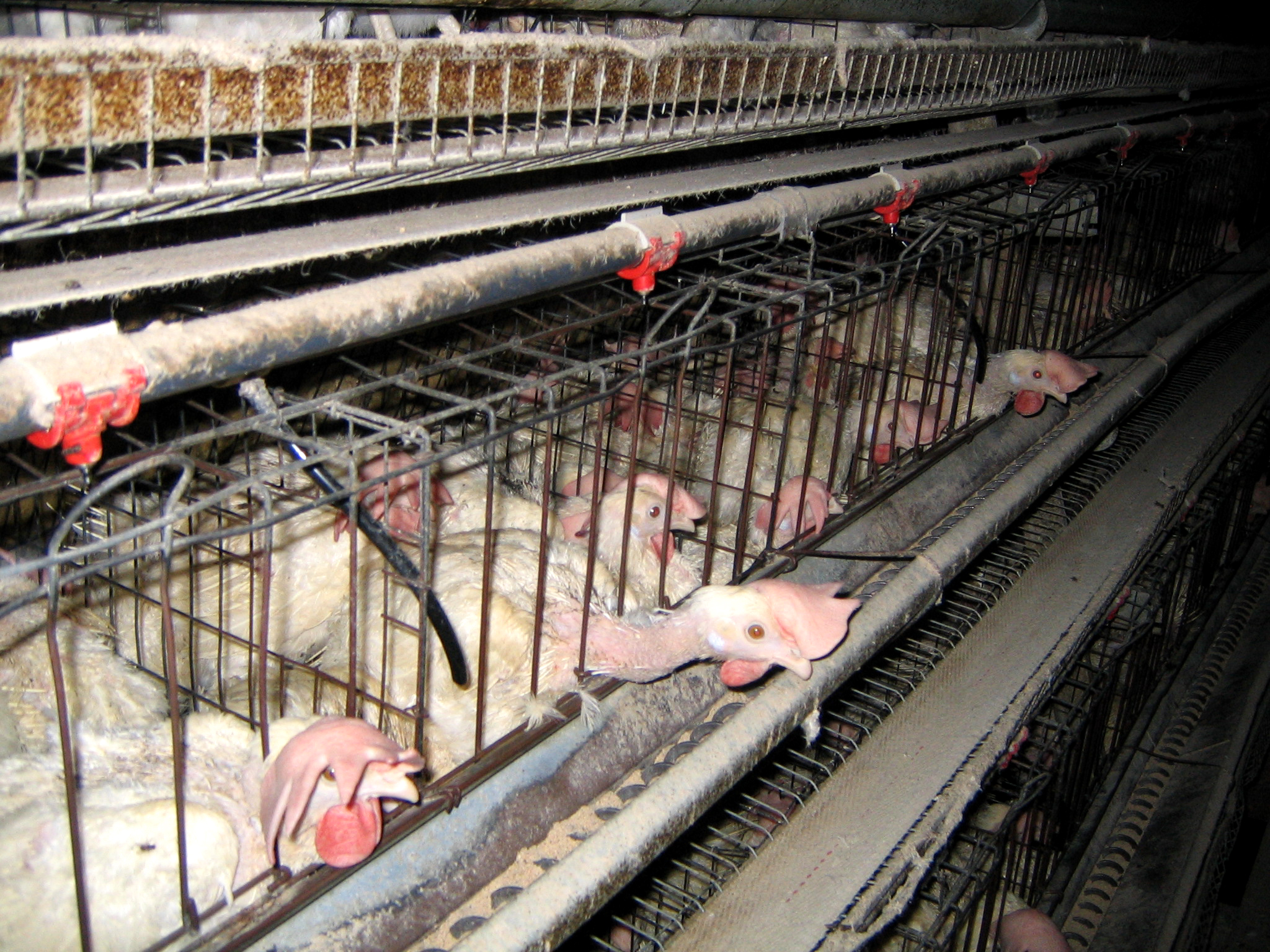
For example, he has shown that hens will work just as hard to find a secluded nesting place as they will to get food, suggesting that the frustration of being denied a nest is as powerful a feeling as hunger.  In Canada, 95 per cent of laying hens are kept in cages that deny them the opportunity to nest.  Science now supports the common sense contention that those caged hens, about 26 million of them, are suffering.

Duncan’s work is underpinned by a broader scientific rethink on animal intelligence and sentience.  In July of this year, a prominent group of neuroscientists gathered at the University of Cambridge to reassess consciousness in human and non-human animals.  The result was the Cambridge Declaration on Consciousness, which, among other things, declared that “Mammalian and avian emotional networks and cognitive microcircuitries appear to be far more homologous than previously thought.”  In other words, birds think and feel more like us than we had supposed.

The declaration has moral and cultural implications, as Dr. Christof Koch, a renowned neuroscientist and signatory to the declaration made clear: “The belief in human exceptionalism, so strongly rooted in the Judeo-Christian view of the world, flies in the face of all evidence for the structural and behavioural continuity between animals and people.”

Some specific studies on chickens have suggested that they possess “primitive self-consciousness.”  Others have found evidence that chickens have “one of the essential underpinning attributes of ‘empathy’; the ability to be affected by, and share, the emotional state of another.”

Even the social behaviours of chickens (in natural settings) indicate they are perhaps not so different from “higher animals” as previously thought. One Australian study found that roosters who lost out to dominant males when it came to attracting hens found alternative routes to romantic success by “being nice” and finding food for hens.  (Human males who never made the football team but still wanted to get dates will be familiar with such strategies.)

But should chickens’ welfare depend on how intelligent or more “like us” they are?  Philosophical debates rage over granting animals moral consideration based on their levels of sentience, intelligence and self-consciousness.  Some would argue that the capacity of an animal to feel pain should be enough to make inflicting such pain morally wrong.

It could also be argued that having intelligence hasn’t saved millions of pigs suffering in factory farms, or whales who continue to be slaughtered, or dogs and primates still used in laboratory research.

Nevertheless, making science-based arguments when advocating compassion for animals does carry weight with those suspicious of mere sentimentalism (although one wonders why the simple concept of mercy isn’t morally persuasive enough).  Proving animals are more intelligent and emotionally capable will, in the long run, make it harder for industries and authorities to justify making them suffer or killing them for human benefit.

Even changing chickens’ image will help.  Science is showing that they are not “bird-brained” “dumb clucks” but sentient, clever birds with unique personalities and interesting social behaviours.  That’s who is suffering on factory farms.  That’s who is being slaughtered by the millions.  That’s who is on your plate – not “just a chicken.”

Categories
News/Blog Uncategorized

Canada’s factory farms exposed

VHS’s contribution to the report concerns Canada’s supply management system and cruelty to caged hens like these ones on an Ontario battery farm.

Report is a must read

The World Society for the Protection of Animals (WSPA) has released some alarming findings about the impacts of Canada’s animal agriculture practices.

What’s On Your Plate? The Hidden Costs of Industrial Animal Agriculture exposes the destructive impacts of intensive livestock operations on our health, the environment, animal welfare and rural Canada.

The report also exposes the real costs of our food, including tax-funded subsidies to agriculture, and the costs borne by our health care system for public safety and food borne illnesses. Our “cheap” food isn’t so cheap after all!

VHS co-wrote a section on supply management and Canada’s egg industry (pages 101-105). Read the report here and take action to help address the issue.

Categories
News/Blog Uncategorized

Big Ag and Calgary Stampede target school kids

Rosy image of factory farming promoted

Conventional egg farm

The corporate power of Big Agriculture and the Calgary Stampede is being used to paint a rosy picture of factory farming to Calgary schoolchildren – with no dissenting voices allowed.

The Stampede’s ‘Aggie Days’ (April 21-22) is an annual event “celebrating” agriculture in Alberta – as long as it’s conventional, intensive agriculture.  Up to  30,000 local schoolchildren visit the promotion each year.

Paul Hughes, a local food activist who promotes small-scale urban agriculture, has been denied a booth at the event for the past four years. Hughes says that his booth would focus on how to grow food in an urban environment, providing information on preparing plots, choosing plants and starting school gardens.   Yet despite such innocuous activities and a pledge not to engage in any political activity, Hughes was again denied a booth.

Other exhibitors, like Alberta Chicken Producers and Alberta Egg Producers, will have booths at the event.  But Hughes, who is president of the Calgary Liberated Urban Chicken Klub (CLUCK), is not welcome.  CLUCK is opposed to factory farming, including battery-cage egg operations. Perhaps the big conventional chicken operations don’t want schoolchildren to hear that hens are happier when they’re not crammed six to a cage.

While VHS has concerns about unregulated urban chickens, CLUCK’s proposals are about responsible urban husbandry that’s subject to regulation that will protect animal welfare.  It’s hard not to admire CLUCK’s fight for a traditional form of small-scale agriculture that respects animals and the environment.  It’s just one more small voice trying to stand up to the overwhelming power of corporate agriculture.

And it’s that corporate power that is being used to silence any voice that questions factory farming.  Meanwhile, Aggie Days will ensure that schoolchildren see a one-sided view of agriculture that suits Big Ag and the Calgary Stampede.


Categories
News/Blog Uncategorized

Hens to end miserable lives as glue

The sticky problem of making money from old hens finally has a solution. They’re going to be turned into glue.

According to a story in the Western Producer, researchers at the University of Alberta say spent hens, which are seen as waste in the industry, can be used to produce wood glue. There’s a “big market” say the researchers.

In Canada at any given time, there are approximately 28 million egg-laying hens. Most of them spend their short lives of 12 to 24 months in wire cages (called battery cages), with each hen having less room than a sheet of paper. The hens are crammed five to seven to a cage with no room to express any natural behaviours such as nesting, wing-flapping, dust-bathing or foraging. The frustration from such extreme crowding causes the birds to cannibalize each other. Industry’s answer to this problem is to cut off the hens’ beaks with a hot blade or a laser, which has been scientifically proven to cause extreme pain.

Until now, the bodies of hens that are no longer considered productive (spent hens) have been worthless, so much so that even transporting them to slaughter was uneconomical. On-farm killing and composting has been encouraged, using methods such as gassing, macerating and electrocution.

There are significant welfare problems with both transport and on-farm slaughter. Transportation of farm animals is poorly regulated in Canada for any species, and the vulnerability of spent hens means they are particularly at risk. Their bones are fragile due to excessive egg production and lack of exercise – between 24% and 29% of laying hens have broken bones by the time they reach the processing plant, according to a 1989 study. The battery cages in which they spend their lives are poorly designed, so even removing them from the cages can cause painful injuries, including fractures. Because of their low economic value, each bird is not treated with care and ‘catchers’ can be extremely rough when removing hens from cages and cramming them into transport drawers.

The trip to the slaughterhouse is fraught with yet more misery, including inclement weather, long transport distances, vehicle vibration, etc. Once there, stressed and suffering, they are again pulled from the containers and hung upside down to have their heads dragged through an electrified water bath (called stunning). Too many birds survive the stunning and are fully conscious as their throats are slit.

While on-farm slaughter addresses the problems with transport, welfare is still a serious issue. Because farms are away from the city, the public, including authorities tasked with oversight of animal welfare, does not see what’s happening. All of the killing methods, including gassing, maceration, and electrocution, can cause terrible suffering.

An improvement in economic value is not likely to result in increased welfare. Spent hens will continue to suffer until the public accepts the painful reality of their lives and deaths.  Their suffering can be reduced by purchasing only cage-free eggs or by cutting out eggs altogether.