Categories
Opinion Editorial

Meteoric rise in plant-based foods marks larger industry trend

Article originally published on Daily Hive.

Is the rising popularity of vegan and vegetarian food just another diet fad? Evidence is emerging that it is not only taking root in a growing number of home and restaurant kitchens but also deep in the food industry.

Diners in Metro Vancouver have seen more vegan eateries opening and more plant-based options at many other restaurants. Shoppers are finding new meatless products appearing on supermarket shelves. Even fast-food joints are pushing veggie burgers. Who didn’t hear about A&W selling out of its new plant-based Beyond Meat burger within hours last summer?

The same is happening across much of the developed world. In Britain, the recent launch of a vegan sausage roll caused a national media sensation, as the product quickly sold out and pundits debated the merits of changing an iconic British snack (The U.K. overtook Germany this year as the world leader for vegan product launches).

Even France, the home of Brie cheese, has seen a rise in meatless eating. French supermarket sales of vegetable protein surged by 82 per cent in 2016, and are set to grow by another 25 percent a year through 2020, according to one study.

Nevertheless, some are skeptical about the attention being paid to plant-based food. The U.K.’s Times newspaper reported last year that the meat industry was scornful of the increased interest in vegan food, stating: “Livestock farmers are being told not to panic about the rise of veganism because it is a passing fad for many young people who are merely following the latest fashion.”

But there are clear signs that the “plant-based revolution” is real.  And it’s not because of a few more vegan cafes and some popular veggie burgers.  The real evidence of change can be found in food business journals, which are reporting a quiet but fundamental shift within the global food industry.

Last year, Ingredion, a giant U.S. food ingredients company, invested US$140 million in manufacturing facilities in Saskatchewan and Nebraska to create flours and concentrates from peas, dried beans, chickpeas and lentils. The company’s CEO explained why: “We’ve identified plant-based proteins as a high-growth, high-value market opportunity that is on-trend with consumers’ desire to find sustainable and good tasting alternatives to animal-based proteins.”

Other companies are doing the same, creating animal-free protein for use in bakery products, cereals, pasta, batters and meat substitutes.  In 2017, the global plant-based proteins market was valued at US$ 10.5 billion and is estimated to reach a value of around US$ 16.3 billion by the end of 2025, according to analysts Persistence Market Research.

The egg industry is also being disrupted, as food companies seek to avoid the market volatility of egg supplies and prices, which are affected by disease outbreaks (avian flu) and recalls (salmonella). Many have turned to plant-based alternatives that fulfil the same function of eggs in baked goods or sauces without compromising flavour.

Other food companies have focused on improving the taste and texture of the new plant-based ingredients, such as removing the bitterness of pea protein or giving non-dairy ice cream the same creamy mouthfeel as the real thing – thus creating the potential to “veganize” just about anything.

These advances come on top of the already successful introduction of non-dairy milks, the launch of popular meat substitutes and high-profile investments in the sector by billionaires like Bill Gates and Li Ka-Shing and Richard Branson.

While many ethical vegans and vegetarians welcome these developments, which open up the possibility of a future without animal slaughter, there are concerns about Big Food’s involvement, especially its over-processing of food.

That’s why many influential vegans and vegetarians advocate for a “whole foods” plant-based diet and recommend keeping processed foods to a minimum.  Desiree Nielsen, a Vancouver-based registered dietitian and host of TV’s The Urban Vegetarian, has said “You can be a junk-food, cheesy-carb vegetarian, or you can be an Oreo- and candy-obsessed vegan.” She says eating processed meat substitutes once or twice a week is fine but diet mainstays should be simpler options like beans and high protein vegetables, preferably home-cooked.

Such advice is certainly having an impact. The rise in meatless products has been matched by an explosion in plant-based cookbooks and recipe blogs, suggesting many people are at least trying to avoid an over-reliance on processed foods.

Whether it’s led by convenient meat substitutes or homemade whole foods, the plant-based revolution looks like it’s here to stay.  And keeping animals off your plate has never been easier.

Categories
animal welfare compassion Cruelty-free Dairy Food and Drink News/Blog plant-based diet Promoted rodeo vegan vegetarianism

Let’s make more animals happy in 2019!

At Vancouver Humane we think every animal deserves to be happy. In 2018, with your support, we helped sick and injured animals to get better; spoke out against animal cruelty and urged people to see animals as friends, not food.


Generous donors ensured our McVitie fund helped 130 animals get emergency medical help or be spayed/neutered. Their families, many on low incomes, appreciated that someone was there to help in a crisis and that their companions would come home safe and healthy.We hope to help even more animals in the new year – with more happy endings!


We continued to expose cruelty at rodeos, including the use of an electric shock device at the Chilliwack Fair rodeoand the abuse of bulls at local bull-riding events.

We’re determined to keep fighting for these animals and put an end to rodeo cruelty.


We also worked on the root causes of animal suffering, especially factory farming and the demand for the animal products that fuel this cruel industry.

During the year, we took a number of actions to promote a plant-based diet, reduce meat and dairy consumption and educate the public about the suffering of farmed animals, including:


  • Supported more schools (now 16!) in increasing their offering of plant-based options through initiatives like Meatless Monday. 
  • Held our first plant-based culinary workshop at the secondary school level, training food service staff on new recipes, cooking skills and techniques. 
  • Ran a new Go Veg bus ad, aimed at reminding viewers that when we were children we instinctively saw animals as friends and not food. 
  • Sponsored and participated in the Capilano University Veg Fest, the first of its kind in Metro Vancouver. 
  • Helped spread the Go Veg message by distributing over 19,000 of our Live Well booklets to local advocates, at events and through our Outreach Team.

We also:

  • Launched a new speakers series called Animals & Ethics in the 21st Century to engage the community in animal issues (Our first speaker of 2019 will be registered dietitian Desiree Nielson on Jan. 10th.) 
  • Called on candidates to declare their positions on animal welfare issues in a local election survey. 
  • Advocated for stronger farmed animal transport regulations. 
  • Called for action on delayed farm animal cruelty charges

With your help, we’ll do even more to help animals in 2019.  Please donate to ensure this work continues. Your support means more animals will be helped, giving them the chance to live the happy lives they deserve.


Thank you and Happy New Year
from all of us at the Vancouver Humane Society!


Categories
Opinion Editorial

New CRISPR gene-editing technique more beneficial to meat producers than to animals

Article originally published in the Georgia Straight.

A controversial gene-editing technology may soon be widely applied to animals, with the livestock and biotech industries claiming that animals will be better off as a result. The truth is more complicated—and perhaps more disturbing—than they would have us believe.

A Chinese scientist stunned the world last month when he revealed he had created the first gene-edited babies using CRISPR (Clustered Regularly Interspaced Short Palindromic Repeats), a powerful new technology that can remove specific genetic traits. The scientist, He Jiankui, has been widely condemned by the scientific community as reckless and unethical, and the case has stoked public fears about the creation of “designer babies”, but CRISPR raises wider ethical implications—in particular, its use with animals.

Researchers have already used CRISPR to edit the genes of a variety of animals, and the creation of gene-edited farm animals is poised to become a commercial reality. The livestock industry and the biotech companies behind it are promoting CRISPR as a boon to animal welfare.

For example, CRISPR can create cows without horns, which are currently removed through painful procedures (e.g., cutting or burning) to reduce risk of injury to other animals and human handlers. CRISPR advocates say the need for those procedures would disappear. Genes can also be altered to make cattle more heat-tolerant or to produce pigs that are resistant to disease, suggesting a future with healthier, more resilient farm animals. Animal-welfare benefits are prominent in media coverage of CRISPR’s potential—and it’s no accident.

Recombinetics, a U.S. biotech company, has been careful to promote these benefits as opposed to the advantages to production. As the company’s chief executive officer, Tammy Lee, told Associated Press“It’s a better story to tell.”

There is another, more ethically complex, story. While some of the applications of CRISPR to farm animals may improve certain aspects of animal welfare, there are fears that, taken together, they will be used to further intensify industrialized animal farming. Hornless, disease-resistant, weatherproof animals are easier to manage, transport, and keep in crowded conditions. There is little incentive for producers to invest in more humane husbandry. In short, cruel factory farming remains. It will just be more efficient.

Researchers are also promoting gene-editing as a means to create “double-muscled” animals (for more meat), but this could also cause unintended health problems. One attempt to produce meatier, gene-edited pigs resulted in deformed piglets that were unable to walk, dying shortly after birth. Double-muscled cattle produced by conventional selective breeding are more susceptible to respiratory disease, lameness, stress, and difficulty giving birth. Gene-editing will make it easier to create such animals, but the welfare consequences will be the same.

Any attempt by Big Agriculture to paint gene-editing as an amazing breakthrough in improving animal welfare should be treated with skepticism. Remember, these are the people who—through selective breeding for more meat—brought us chickens that grow so fast they are crippled by their own weight, leading to heart disease, skeletal disorders, and lameness. They are the architects of a system that has crowded billions of animals into cages, crates, feedlots, and transport trucks, causing incalculable suffering. Can they and their biotech partners really be trusted when they claim that they’re advancing a world-changing technology just to make animals happier?

Even if these industries are sincere in their promotion of gene-editing to improve farm-animal welfare, their proposals amount to applying technological, piecemeal quick fixes to the cruelty of factory farming, a problem requiring abolition, not tinkering.

Industrialized animal agriculture has been shown by science to be not only cruel to animals but also devastating to our environment and detrimental to human health. It’s a system that can’t be fixed. But it can replaced—by one that focuses on the production and consumption of plant-based foods.

The rise in popularity of plant-based alternatives to meat has been well-documented. Vegan and vegetarian foods are now competing with animal-based products on taste, price, and convenience. Investment and innovation in plant-based foods have exploded in the past few years and look set to continue. (The Economist magazine is calling 2019 “the year of the vegan”.) These developments offer a different path forward, one without mass animal suffering, environmental degradation, and the negative health consequences of a meat-heavy diet.

The other path, which maintains our dependence on animal incarceration and slaughter, promises only to further commodify animals by engineering them to suit our needs and desires. It’s a path to a world in which animals have no value beyond their use to humans.

By perpetuating the treatment of animals as products we not only diminish them but also ourselves and our humanity.

Categories
Opinion Editorial

Why BC chicken abuse charges should serve as warning to all farms

Article originally published on Daily Hive.

Charges against two B.C. businesses for animal abuse may serve as a warning shot to other companies in the agriculture industry that they, and not just individual employees, are accountable for any mistreatment of the animals they raise, transport and slaughter.

Last week, the Canadian Food Inspection Agency (CFIA) laid charges against Sofina Foods, Elite Farm Services and Elite’s president, Dwayne Dueck, for allegedly beating chickens and loading them in a way “likely to cause injury or undue suffering.”  They are scheduled to appear in court today, December 18.

The charges stem from video footage released by animal activists in June 2017 that showed chickens at a Chilliwack poultry operation being mangled, stomped on, thrown against a wall, and smashed into transport crates. The BC SPCA, which described the abuse as “absolutely sickening,” recommended charges, but a year and a half later Crown Counsel has still not prosecuted anyone.

The CFIA, however, has pursued charges under federal Health of Animals Regulation, which may financially penalize the companies.

When the alleged offences became public, the companies involved were quick to distance themselves from the revelations.  Sofina Foods called the footage “horrifying” and said it had requested that all of the employees involved be dismissed immediately.

Elite’s Mr. Dueck stated: “We are sickened with the footage and want to ensure all our suppliers and producers that this is not reflective of who we are, our fundamental beliefs or behaviours we accept from our employees.”

Six of Elite’s employees were fired but now it is the companies that are being held to account for alleged animal abuse, a development that should send a signal to others in the livestock industry that they can’t escape responsibility for what happens to the animals they profit from.

For too long, industrialized animal farms have been in a state of denial about animal suffering that occurs in their business.  When the 2017 undercover video emerged, the B.C. Chicken Marketing Board said: “It does not represent in any way, shape or form, how we do our business, not only here but anywhere in Canada.”

Yet, for years, undercover animal activists have exposed numerous cases of animal cruelty on farms across Canada, the U.S. and elsewhere.

The ease with which the undercover investigators have been able to find and reveal abuse suggests that animal cruelty in intensive farming is not the rare occurrence that operators claim.

Media coverage of animal cruelty on industrialized farms in the United States has become so commonplace and damaging to the industry that it has lobbied for “ag-gag” laws criminalizing undercover videos of the cruelty.

It shouldn’t be forgotten that some of these videos expose not only illegal acts of cruelty but also standard practices on industrialized farms that result in misery for animals.  For decades, millions of hens have suffered in cruel battery cages, that are only now being slowly phased out (and may be replaced with only marginally better “enriched” cages). Pigs and chickens are routinely transported in cramped trucks over long distances in extreme heat and cold.

Much of the suffering on factory farms is invisible to the public.  Science has shown that poultry raised for meat experience painful skeletal disorders and lameness as a result of selective breeding for fast growth. And despite the images of happy cows in pastures on milk cartons, most dairy cows in Canada are kept indoors, never feeling the sun on their backs.

Even animal agriculture’s own internal monitoring systems reveal poor animal welfare.  In 2016, inspection reports from the B.C. Milk Marketing Board, made public by media, showed that one in four farms in the province failed to comply with the provincial animal-welfare Code of Practice. During an 18-month period starting in January, 2015, the inspections revealed cases of overcrowding, lame or soiled cattle, tails torn off by machinery, branding and dehorning of calves without pain medication, and other examples of poor welfare.

The CFIA’s charges against Sofina Foods and Elite Farm Services should be welcomed, as they may encourage others in the industry to do more to prevent the kinds of extreme cruelty seen in undercover video footage.  However, no one should forget that this is an industry that incarcerates, transports and slaughters animals in conditions that compromise animal welfare but are not illegal.

Ultimately, the best way to help these animals is to reject factory farming entirely and stop buying the products this cruel industrial system produces.

Categories
animal welfare compassion cruelty News/Blog Promoted rodeo

The truth about bull-riding

Tormenting animals for entertainment is unacceptable

Earlier this year, we were dismayed to see two events staged in Abbotsford that saw bulls tormented and taunted for the sake of entertainment.

One was an “extreme rodeo” event held at Abbotsford’s Exhibition Park, some of which can be seen in this video.  It’s clear that the bulls want no part of this sad spectacle. VHS complained to Abbotsford City Council, which owns the venue, but received no response.

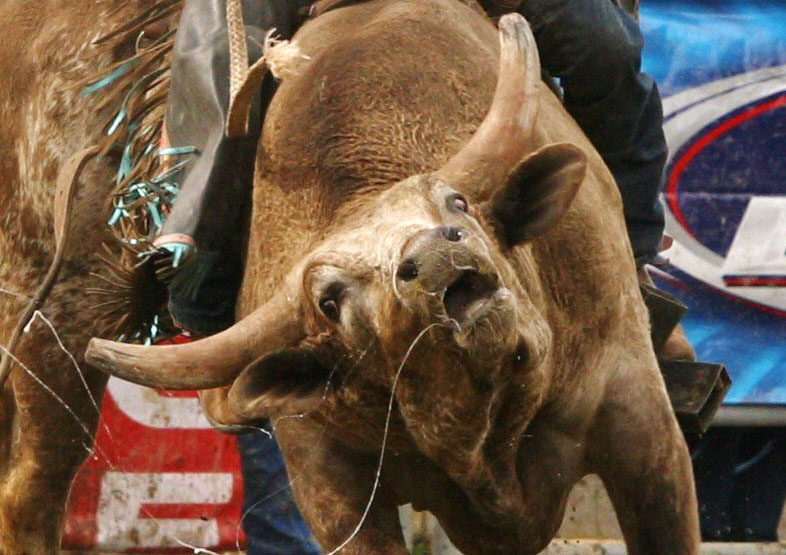
The other was a Professional Bull Riders (PBR) event at the Abbotsford Centre, a venue also owned by the City of Abbotsford.  Again, bulls were exploited for human amusement, obviously distressed as they bucked wildly to get unwanted riders off their backs.  In addition, they were exposed to loud fireworks despite the fact that sudden noise is known to cause distress in cattle.

Bull-riding has become popular in recent years, as fans see it as a sensational contest between “man and beast.”  Few people feel empathy for the bulls, as they weigh us much as 2000 pounds and are seen as ferocious and powerful.  PBR and rodeo promoters say the bulls are star “athletes” and are born to buck, even though they have no choice but to participate.


Why do bulls buck?

The truth is that the bulls are selectively bred for a predisposition to buck, which means they are especially sensitive to any negative stimulus, such as the riders they are trying to buck off. This is thought to be an evolutionary response to a predator jumping on the bull’s back.  In other words, the bull feels it is under attack and is fighting for its life.  The wild bucking seen at these events does not occur outside the arena.

In addition to being mounted by the unwanted rider, a “flank strap” is cinched tight around the bull’s torso just before it is released into the arena.  This causes the bull discomfort, creating yet further negative stimulus to induce the bull to buck harder.  One study on bucking bulls puts it very clearly: “The purpose of the flank rope is to produce an annoyance to the bull.”

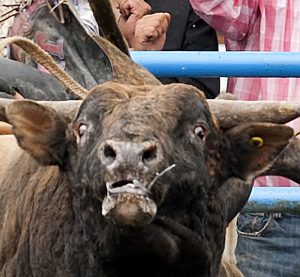
Bull showing “eye white” – a sign of fear and stress

.
While the rodeo and bull-riding industries deny bulls are suffering, it is clear to any objective observer that the bulls’ wild bucking is an unnatural, negative experience.  One indicator of the bulls’ distress is the presence “eye white” (an increase in the size of the white of the eye surrounding the pupil), which can be seen in photos of bull-riding events.  Eye white has been identified as sign of fear and distress in cattle. One 2017 study states: “The work to date suggests that eye white percentage is a meaningful indicator of emotion, with more eye whites indicating fear and frustration and less eye white associated with positive feelings.”

Although it is difficult to see what happens behind the scenes in the chutes before a bull is released, there have been instances at rodeos where bulls have been kicked, had their tails twisted or have been electrically shocked – all to ensure bulls leave the chutes angry, fearful and bucking wildly. VHS exposed the use of an electric shock device at the Chilliwack rodeo’s bull-riding event in 2018.

While bulls can exhibit aggressive behaviour, they are not the inherently “mean” or “ornery” animals described by PBR promoters.  Their levels of aggressive behaviour are determined by a mix of breeding and environment. For example, if they are isolated from the herd and put in an unfamiliar setting they are likely to be more aggressive.  Otherwise, aggressive behaviour is manifested when bulls are provoked – such as being mounted by an unwanted rider or stressed by a flank strap.

Bucking bulls are also “trained” through the use of dummies, which are metal weights placed on their backs and released when they buck their hardest, thus conditioning the bull to buck harder to gain relief from the distress caused by the weight.


Physical harm to bulls

There is evidence that bucking bulls may suffer physical damage from the events they are forced to participate in.  A 2017 study states that: “Results indicated bucking bulls were more likely than nonbucking bulls to develop horn and sinus disorders and musculoskeletal disorders of the vertebral region and pelvic limbs.”

While there are no independent statistics on bull injuries, there are certainly instances of bucking bulls suffering catastrophic injuries, such as in this video.


Injuries to humans

Although not an animal welfare issue, it is well known that bull-riding causes numerous injuries to human participants.  A 2007 research paper comparing injury rates in various sports found that bull-riding had an injury rate 10 times greater than American football.  The report concluded: “As a result of these analyses, it is a simple matter to conclude that there is a universal difference in the injury rates between bull riding and most other sports; and these authors, therefore, are compelled to declare the sport of bull riding to be the most dangerous organised sport in the world.” An earlier study suggests about 10 per cent of bull-riding injuries are concussions.

The PBR glorifies the danger of bull-riding, even producing a videos of the worst “wrecks” at its events.  Many boys and young men are drawn to the macho culture, money and adrenalin rush of bull-riding, despite the high risk of long-term physical harm, including potential brain damage.


Take action

Despite being inhumane to bulls, as well as unduly dangerous to humans, bull-riding has grown in popularity.  VHS is urging the public to complain to the venues that host PBR and rodeo bull-riding events. Here are some actions you can take:

Contact Abbotsford City Council to urge them to stop rodeo events at city-owned venues by emailing info@abbotsford.ca or writing to:

Mayor and Council
City of Abbotsford
32315 South Fraser Way
Abbotsford, B.C.
 V2T 1W7

Contact the Abbotsford Centre to urge them to stop hosting PBR events by emailing the centre’s general manager, Andrew Nash, at anash@abbotsfordcentre.ca or writing to:

Andrew Nash
General Manager
Abbotsford Centre
33800 King Road
Abbotsford, BC
V2S 8H8

You can support our campaigns against rodeo and bull-riding events by donating here.

More information on rodeo.

Categories
animal welfare compassion cruelty Cruelty-free Dairy Food and Drink fundraising News/Blog plant-based diet Promoted vegan vegetarianism

On Giving Tuesday you can fight factory farm cruelty and help rescued animals

The Vancouver Humane Society and The Happy Herd Farm Sanctuary are partnering to raise funds to help animals now and in the future

Every year in Canada, more than 800 million animals are raised on cruel factory farms before they are sent for slaughter. They suffer from confinement and from being denied the chance to live and behave naturally.  Yet science has shown that each animal, just like your pet cat or dog, has his or her own unique personality. That’s why we say every animal is someone, not something.

This year, on Giving Tuesday, November 27th, we are again partnering with The Happy Herd Farm Sanctuary to make life better for farmed animals.  Giving Tuesday is the annual opportunity to put your dollars toward a cause that’s near and dear to your heart – this year, we hope you’ll make it the plight of animals on factory farms.  All donations will be split between both charities.

At VHS, we work year-round to draw public and media attention to the treatment of farmed animals. Our Go Veg campaign encourages people to try a plant-based diet, which reduces the demand that drives factory farming. We’ve launched our Meatless Monday initiative in 17 Metro Vancouver secondary and post-secondary schools, helping to introduce a compassionate, healthy and sustainable diet to the next generation.  And our rodeo campaign is exposing cruelty and showing that “livestock” are not just commodities to be brutalized for entertainment, but sentient animals capable of feeling physical and emotional pain.

Our partners at The Happy Herd Farm Sanctuary have shown how rescued farmed animals, free of cruelty and confinement, can flourish as individuals. The sanctuary provides a forever home for all types of animals where they can live out their entire lives in a beautiful, natural setting where they are treated with kindness and respect. Visiting Happy Herd and meeting the animals can be a life-changing experience. You will quickly see them as “friends, not food.”

On November 27th, you can donate directly to our joint appeal, but you can also help by supporting the generous (and cruelty-free) local businesses who are partnering with VHS and Happy Herd. On Giving Tuesday, they will be launching a variety of special offers and promotions, all raising funds to help us help animals.  Watch our website and social media channels for updates as we get closer to November 27th – or sign up for our action alerts.

Giving Tuesday is your chance to make life better for farmed animals.  Don’t miss it!


Categories
animal welfare compassion Cruelty-free News/Blog plant-based diet Promoted Recipes vegan vegetarianism

Make sure it’s a safe and Happy Halloween for animals


Halloween is a time for fun but it can be a difficult time for animals.  Here are some things you can do that will help ensure animals enjoy the occasion too.

Keep animals inside – The noise from fireworks, trick-or-treaters and parties can be stressful for animals, so please ensure they are kept inside on Halloween. It’s also a good idea to ensure pets are wearing identification at all times in case they get out.  Pets should also be kept away from the front door, as they may find a constant stream of noisy visitors threatening. 

In Vancouver, the City makes a family fireworks permit available from October 25 to 31, to discharge fireworks on Halloween. VHS would like to see a complete ban on fireworks in the city, which not only adversely affects pets, but also urban wildlife. You can sign a petition for a ban here.

Keep Halloween treats away from pets – Candy should be kept secure and away from pets, especially chocolate, which is very toxic to dogs.  Sugary candy, raisins and some nuts are also toxic, as are some artificial sweeteners such as Xylitol.  Even ingested wrappers can cause bowel obstructions.

Be careful with decorations – Materials like tinsel, ribbon and string are dangerous for pets, as they may cause severe injury to the intestinal tract if swallowed, so keep decorations away from them. Be careful with strings of lights and extension cords to avoid risk of pets getting an electric shock. Remember that pets can knock things over, so keep Jack-O-Lanterns and other decorations with candles out of their way.

Don’t go overboard with pet costumes – While pets in costumes can be adorable, they can also make animals uncomfortable and stressed. Watch for signs of anxiety or distress and don’t force anything on a reluctant pet. If your pet doesn’t mind a costume, make sure it doesn’t significantly limit movement, hearing, eyesight, or the ability to eat food or drink water.

Remember that not every animal likes to party – Keep an eye on your pets at parties, or better yet, keep them in a separate room.  Noisy crowds, strangers, loud music, drugs & alcohol, food falling on the floor – all can present risks and create a stressful environment for animals.

Avoid “pumpkin patches” that display animals – In recent years, pumpkin patches and corn mazes on local farms have become Halloween attractions.  Some incorporate petting zoos, putting farmed animals on display and allowing the public to interact with them.  This can be stressful for farmed animals, as they cannot escape unwanted attention.  It’s worth remembering that these animals are not pets, are being displayed for profit and may later be sent for slaughter like all farmed animals. It’s a good idea to call the venue first and ask whether animals are part of the attraction and under what circumstances.

Try a plant-based Halloween – There are lots of ideas and recipes online to make your Halloween plant-based and cruelty-free.  Here are a few helpful links:
Halloween items at Vegan Supply
Recipes from Choose Veg
Recipes from VNutrition
Vegan Halloween candy guide from Cooking Light
The Food Empowerment Project has a free app listing vegan chocolate suppliers

Give your leftover pumpkins to an animal sanctuary – Sanctuaries for farmed animals can often use leftover produce, including pumpkins, for feed. The Happy Herd Farm Sanctuary and the Little Oink Bank Pig Sanctuary are two local groups you can contact to see what their hungry animals need.


Categories
Media Release

New poll shows majority of Chilliwack residents oppose rodeos

Vancouver- The Vancouver Humane Society (VHS) has asked candidates for Chilliwack mayor and council to state their position on the controversial Chilliwack Fair rodeo, as a new poll reveals that most Chilliwack residents are opposed to rodeos.

The poll, commissioned by VHS from Research Co., found that 52 per cent of Chilliwack residents are opposed to rodeos, with 40 per cent in favour.  VHS has provided each candidate with the poll results.

The poll also found that 62 per cent of B.C. residents are opposed to rodeos, with 29 per cent in favour.  It also found that 70 per cent of B.C. residents aged 18 to 34 are opposed to rodeo, with 25 per cent in favour.

“The poll shows that most people in Chilliwack don’t agree with rodeos and we’d like to hear the candidates’ response to that,” said VHS spokesperson Peter Fricker.  “It also shows that there is little support for rodeo among younger people in B.C., suggesting rodeos will become even more unpopular in the coming years.”

Fricker said that VHS hoped candidates would be forthcoming with their views, given the public controversy over the Chilliwack Fair rodeo during the summer.  “We think people running for office should be willing to give their position on a matter of public interest,” he said.  Each candidate was contacted by email on September 25.

-ends-

Categories
animal welfare compassion cruelty Cruelty-free Food and Drink News/Blog plant-based diet Promoted Recipes vegan vegetarianism

This year, have a compassionate, plant-based Thanksgiving

Try these plant-based ideas for Thanksgiving Dinner

Every year in Canada, 20 million turkeys are slaughtered, with many ending up on dinner tables for Thanksgiving.

Most turkeys are bred for fast growth, which causes them to be top-heavy, leading to painful bone deformities and lameness. Most are raised in cramped conditions on factory farms, where they suffer boredom and frustration because they lack the space to express natural behaviours. They are also subjected to painful beak trimming and toe trimming without pain medication.

A plant-based Thanksgiving is a compassionate alternative to eating turkeys or other animals for the celebration. The good news is that there are plenty of  cruelty-free options and resources for a meat-free holiday.  Here are our suggestions on how to enjoy a compassionate Thanksgiving dinner in Vancouver.

A great option is the Annual Compassionate Thanksgiving Potluck Celebration on October 8th, which this year is being hosted by Vancouver’s Meatless Meetup and Vegans of UBC. Proceeds from this family-friendly event will go to cover costs and to support Earthsave Canada’s school talks program.

If your budget allows some fine dining, Vancouver’s upscale plant-based restaurant, The Acorn, is offering an ‘Everything but the Bird Thanksgiving Feast’ on October 7th and 8th, which it says will be an “indulgent, wildly seasonal” three-course dinner for $45 per person with optional wine pairings.

But if, like most people, you plan to prepare your own holiday dinner, there’s no shortage of alternatives to turkey.  There are a number of great meatless roasts available from Vancouver’s Vegan Supply, including offerings from Gardein, Field Roast and Tofurky.

And, of course, there are plenty of online recipes and suggestions for a plant-based Thanksgiving.  The Oh She Glows recipe website offers lots of ideas, as does The Food Network and even this Toronto yoga centre’s site.

Plant-based choices for special celebrations are increasingly common, making it easy to enjoy a cruelty-free holiday feast. 

Have a happy – and compassionate – Thanksgiving!


Categories
animal welfare compassion Cruelty-free News/Blog plant-based diet Promoted vegan vegetarianism

Don’t miss Capilano VegFest on September 27!

Great plant-based food. New vegan products. Compelling speakers.

Delicious plant-based food is just one of the reasons not to miss the first ever Capilano VegFest on September 27 at Capilano University. You’ll also find amazing cruelty-free, vegan products and services – and you’ll have an opportunity to learn more about living a compassionate lifestyle from expert speakers.

The event will feature 20 vendors, including some of Vancouver’s favourite vegan hotspots like Blue Heron Cheese, Nora’s ice cream, Willow’s Wax Bar, and Herbaland.

There will also be 10 presentations throughout the day on intriguing topics such as how the animal agriculture industry markets itself; what it’s like to be a professional vegan athlete; and how to raise a healthy, vegan family. Speakers include notable content creators, athletes, and other local vegan personalities, such as Anna Pippus, an animal rights lawyer and vegan mother; Geoff Regier, a former undercover investigator for Mercy for Animals; and even a 12-year-old passionate vegan advocate, Zoom the Vegan Kid.

You’ll have the chance to win several door prizes including a variety of vegan snacks and other foods from local vendors; gift-cards to vegan restaurants in Vancouver such as Meet, Chickpea, Virtuous Pie, and Heirloom; a signed copy of television host Lauren Toyota’s cookbook “Vegan Comfort Classics”; and several cruelty-free beauty and self-care items. 

The VegFest is being organized by the Capilano Vegan Club, whose president, Maclayne Simone, hopes the idea spreads: “There was all this culture surrounding sustainability and kindness at Capilano, but close to no initiatives involving veganism,” Simone says. “We wanted to change that. All summer, a group of a few women have worked so hard to bring this event to life and really kickstart the vegan community at Capilano and motivate others to host similar events at their schools. Our goal is to approach veganism in a way that is inspiring and to demonstrate how easy it is to make such a huge difference in the world!” 

The Vancouver Humane Society is honoured to sponsor Capilano VegFest because we know it will make difference.  Make sure you’re there so you can too!

Capilano VegFest
Thursday Sept 27, 2018
11:30am – 4:00pm
Capilano University’s
Birch Building