Categories
animal welfare compassion cruelty Cruelty-free Food and Drink News/Blog Promoted vegan vegetarianism

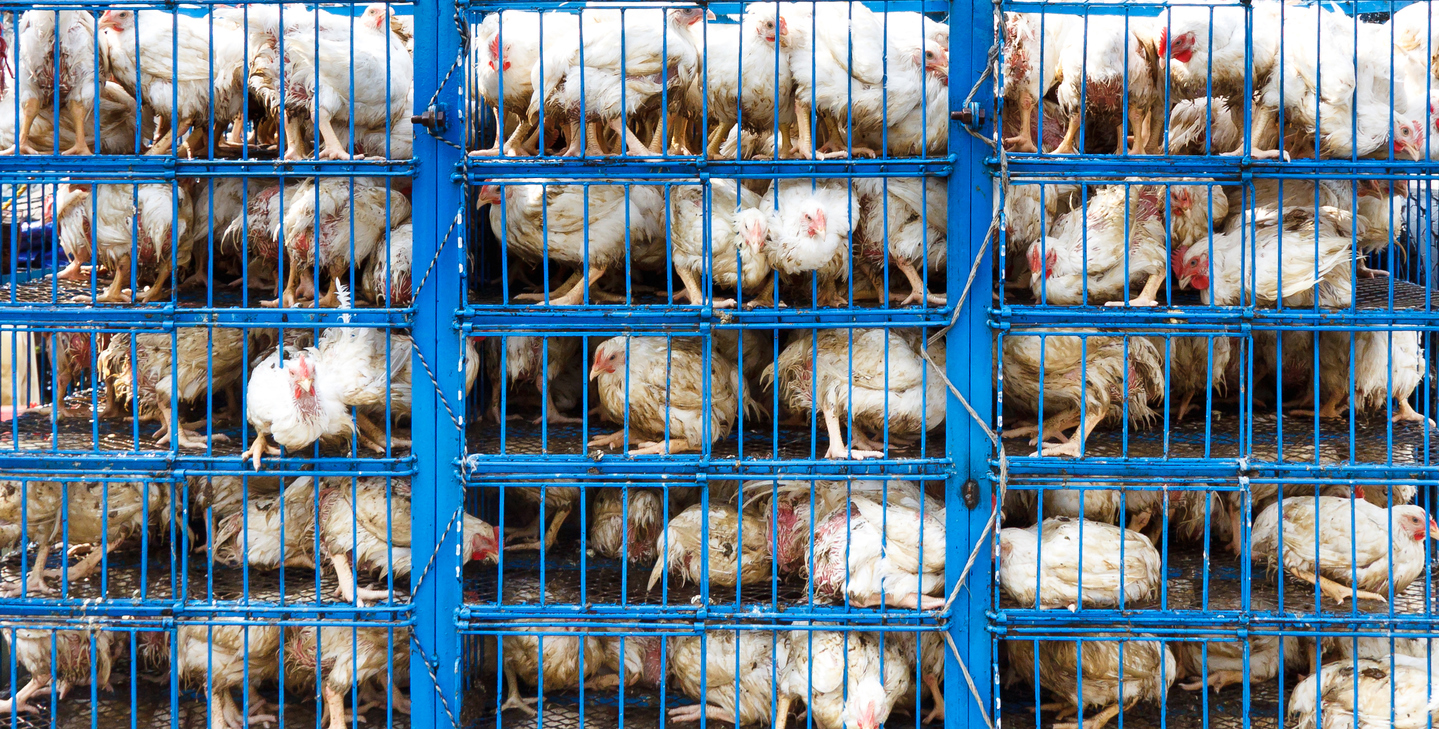
Best way to improve chicken welfare? Don’t eat chicken.

The meat and livestock industry has been under sustained pressure to improve animal welfare but sometimes their responses to that pressure, even when genuine, can create complicated new problems.

Recently, the Globe & Mail published an article on the challenges of producing “slow growth” chickens. It described the efforts by producers to address the consequences of selective breeding in the poultry industry, which has led to fast-growing chickens with horrific health problems.

Chickens raised in the 1950s weighed about two pounds when full grown. Now chickens weigh more than nine pounds.  Breeding for unnatural fast growth and more breast meat has created birds that suffer from painful broken bones, lameness, and heart disease.

The Globe piece details how industry, agricultural scientists and animal welfare experts are trying to produce a “better bird” that will appeal to consumers, have better health, be profitable to raise and be environmentally sustainable.  This is proving to be challenging, as slower-growth birds require substantially more water and feed (because they live longer), which means more impact on the environment and higher production costs.  Considerable resources are now being devoted to solving this conundrum.

While any effort to improve animal welfare is laudable, it’s hard to avoid the obvious question: Why not just stop eating chicken?  The advantages of switching to a plant-based diet are clear and well-documented.  For animals, lower demand for meat means less factory farming and slaughter. For the environment it means less deforestation, lower greenhouse gas emissions and less demand for land, water and other resources.  For human health, it means fewer chronic health problems linked to meat consumption.

The resources currently being devoted to producing “better” factory-farmed animals could be devoted to developing a new, plant-based food system.  Science funding could be applied to research into alternatives to animal protein, improvements to protein crops such as pulses and ways to use these crops in new food products.  Government could support public information campaigns to promote a plant-based diet, help plant-based start-ups and invest in research and development to underpin a new agricultural economy that no longer depends on inhumanely incarcerating and slaughtering billions of animals.

To a small degree, this is already happening.  The new Canada Food Guide is expected to put more emphasis on the benefits of a plant-based diet.  The federal government has started to fund major initiatives to develop plant-based foods.  And polls show many Canadians are open to reducing meat consumption.  The opportunity is there, but is the political will?

While a transition to a plant-based food system faces many barriers and will take time, it is the simplest and most effective way to address the unacceptable consequences of our current cruel, unhealthy and environmentally disastrous food system. 

Categories
Media Release

Photos show electric shock devices in use at Chilliwack Fair rodeo

Vancouver – The Vancouver Humane Society (VHS) has obtained photographs showing an electric shock device apparently being used on animals at last weekend’s Chilliwack Fair rodeo.  VHS says such devices are cruel and should not be used to make rodeo animals perform.  The society says it will make a formal complaint to the fair and will demand an explanation as to why the electric prods were present.

VHS says the photos show the device being held by a man preparing bulls for release from the chutes in several bull-riding events at the rodeo.  The device appears to be an electric prod known as a “Hot-Shot”, which can generate 4500 volts.

“No animal should be exposed to electric shocks just to make them perform for a crowd,” said VHS spokesperson Peter Fricker.  “Rodeo animals already suffer from being roped, spurred and goaded into performing.  Now they have to endure electric shocks as well?”

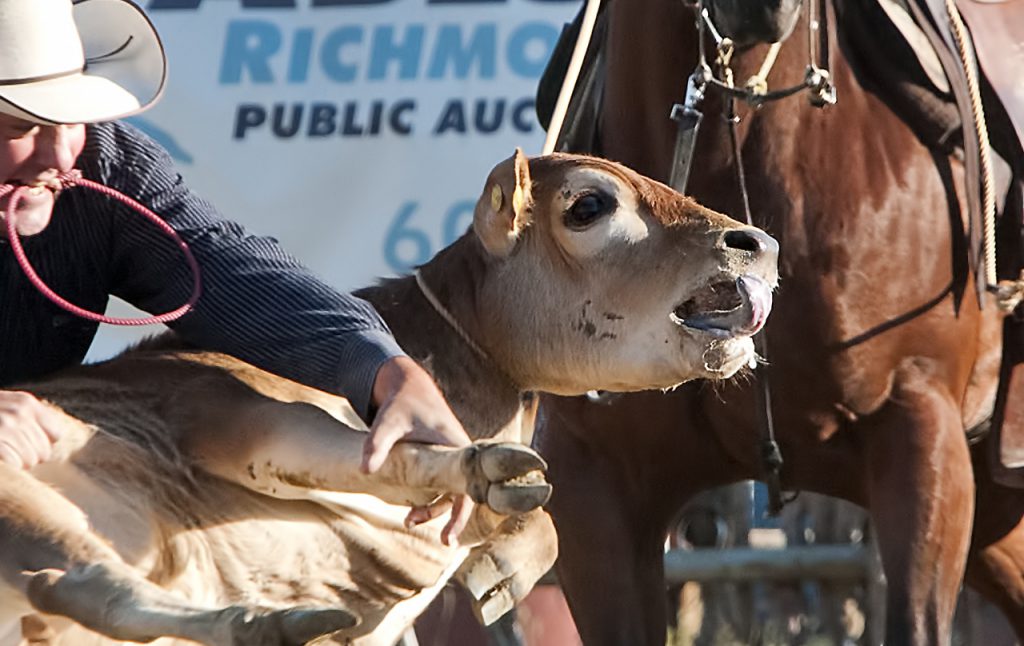
VHS also obtained a number of other photos at the rodeo, which it says clearly shows rodeo animals in distress.

-ends-

Categories
Media Release

Pamela Anderson tweets her opposition to Chilliwack Fair rodeo – August 8, 2018

Superstar and B.C. native Pamela Anderson has added her voice to a campaign against B.C.’s Chilliwack Fair rodeo, which starts this Friday.

Anderson yesterday tweeted her support for the campaign by the Vancouver Humane Society (VHS) calling for an end to cruel rodeo events at the fair. Her tweet to more than a million Twitter followers said: “Let’s end rodeo cruelty in Chilliwack.”

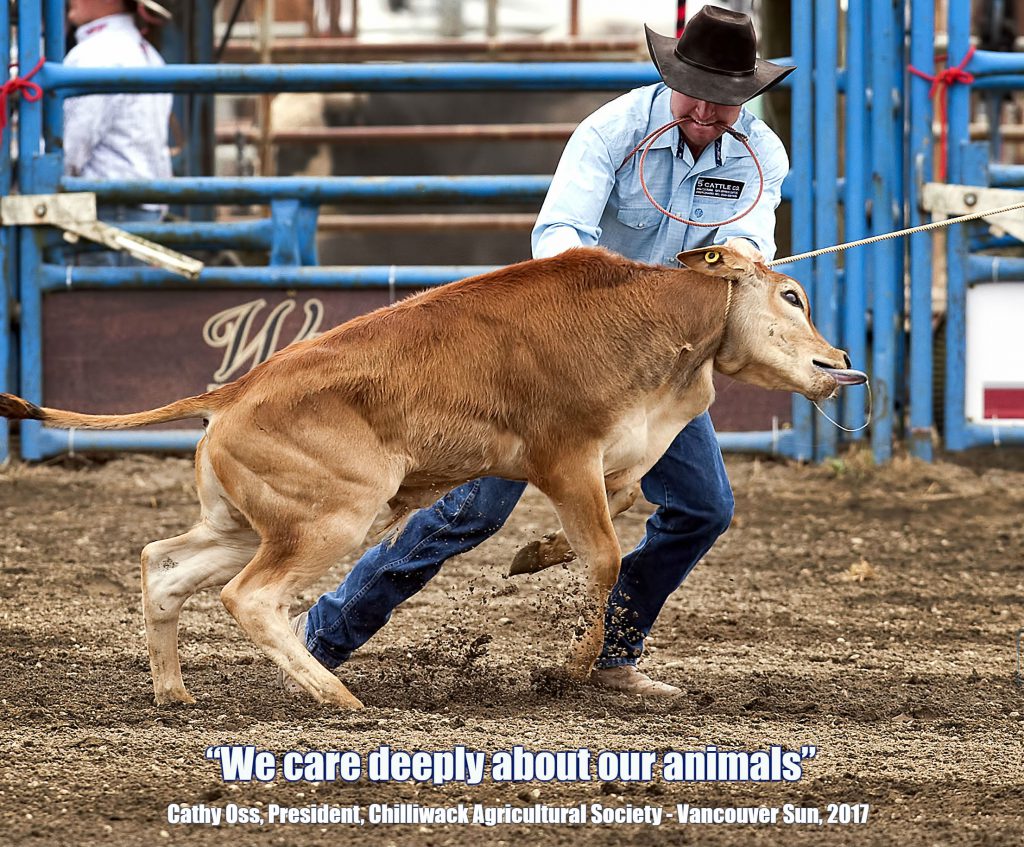
VHS has been calling for an end to cruel events such as calf-roping, steer-wrestling and team-roping at the fair’s annual rodeo and urging local businesses and residents not to support the event. “There is no doubt that animals suffer in rodeos and people who care about animals should take a stand against the cruelty involved, said VHS spokesperson Peter Fricker.

“We appreciate Ms. Anderson’s support and acknowledgment of the inherent cruelty involved,” Fricker said.

VHS has published online photos of rodeo animals in distress taken at previous Chilliwack Fairs.

-ends-

Categories
Opinion Editorial

Let’s put an end to events that torment animals

Article originally published in the Vancouver Sun.

Most people care about how kittens and puppies are treated, but how many people have empathy for a 2,000-pound bucking bull?

The rodeo and bull-riding industries say bulls are mean and “ornery” and, of course, dangerous. They also call the bulls “athletes” — as though bulls have chosen a career in sports in the same way a football player might. They say bulls are just doing what they love to do.

The truth, however, is a different story. Bull-riding events depend on unnatural, coercive and inhumane treatment of bulls.

First, the bulls are bred to buck — a fact bull-riding promoters commonly use to defend the “sport.” But this only means that bulls are bred to have a genetic predisposition to buck. And it doesn’t mean the animal will enjoy bucking. It’s equivalent to breeding dogs for aggression or fear or to have a sensitivity to some form of negative stimulus.

In bull-riding there’s plenty of negative stimulus to make the animal buck. It has an unwanted rider on its back, who is wearing spurs that grip the bull’s hide. Just before the bull is released into the arena a “flank strap” is tightened around its hindquarters, which further induces bucking.

The flank strap is much debated, with rodeo supporters arguing that it’s just a “signal” to the bull to start bucking or that it just makes the bull buck harder. At most, they say, it’s a mild irritant. In fact, just like the unwanted rider and the spurs, the flank strap is causing the bull distress. Consequently, it enters the arena bucking wildly. It wouldn’t behave so otherwise.

The B.C. Prevention of Cruelty to Animals Act states that: “A person responsible for an animal must not cause or permit the animal to be, or to continue to be, in distress.” However, livestock are effectively exempted from the act, if “the distress results from an activity that is carried out in accordance with reasonable and generally accepted practices of animal management that apply to the activity in which the person is engaged … ” 

The drafters of the act presumably had in mind agricultural practices such as branding cattle, which would be illegal if applied to dogs or cats. Until challenged in court, it seems rodeo events like bull-riding will qualify for the same exemption, despite having no agricultural purpose. Sadly, this means the bulls, calves and steers in rodeos don’t get the same legal protection from abuse as other animals.

Again, many will say: why care about bulls? They’re just livestock. Contrast this lack of public empathy with, say, captive whales or dolphins. For years, animal advocates and thousands of concerned citizens have rightly fought to end the keeping of cetaceans in marine parks and aquariums because it’s inhumane to hold them in tanks. The debate between pro and anti-captivity supporters has been fierce, with intense media attention about the issue.

But imagine if dolphin trainers applied deliberately stressful, physical methods — the equivalent of spurs and flank straps — to make the dolphins perform. There would be no debate. No civilized person would stand for it.

Some will argue: yes, but cetaceans are intelligent, beautiful and graceful, bulls not so much. But should we deny compassion and empathy to animals that are not as charismatic as others? As Jeremy Bentham reminded us, the only question that should matter is “can they suffer?”

On Sept. 15, Abbotsford’s Exhibition Park will host what has been billed as an “extreme-rodeo” event, featuring bull-riding, “extreme freestyle bullfighting” and “Mexican bull poker,” all of which involve stressing bulls to make them perform. Animal advocates are calling on Abbotsford city council, which owns the venue, to cancel the event.

The Chilliwack Fair rodeo (Aug. 10-12) also features bull-riding, along with controversial events such as calf-roping and steer-wrestling, which animal advocates are campaigning against.

All animals deserve our empathy and respect, even the strong and powerful.  Isn’t it time we abolished events that depend on the taunting and tormenting of animals to entertain us? The cities of Abbotsford and Chilliwack could make a bold stand for compassion and kindness toward animals by doing just that.

Categories
Opinion Editorial

Is consumer change the only way to reduce cruelty in industrialized agriculture?

Article originally published in the Georgia Straight.

The blurb on a local tourism website says B.C.’s Fraser Valley “is known for its historical roots, agriculturally rich soils, and awe-inspiring vistas.”  Sadly, it’s also becoming known for some of the most horrific cases of farm-animal cruelty in Canada.

In June, undercover video released by animal activists showed horrific conditions at three Abbotsford egg farms, including footage of chickens, some still alive, buried up to their necks in feces. The video was turned over to the B.C. SPCA, which said it was “investigating another situation where chickens have allegedly suffered as a result of what appears to be a blatant disregard to adherence of the industry’s own agreed-upon standards of care and a failure to either comply with or put in place processes to ensure this type of suffering does not occur”.

It has since emerged that one of the operations being investigated by the B.C. SPCA is chicken-catching company Elite Farm Services, which was named in a major animal-cruelty case in Chilliwack last year.

In that case, footage obtained by animal activists showed chickens being mangled, stomped on, thrown against a wall, and smashed into transport crates. The B.C. SPCA recommended charges, but more than a year later Crown counsel has still not prosecuted anyone.

Crown counsel did charge dairy company Chilliwack Cattle Sales and several of its employees in a shocking animal-cruelty case in 2014.  Again, undercover animal activists obtained video, this time revealing dairy cows being beaten with chains and kicked and punched in the face by workers. Other cows were shown with open wounds and infections. Chilliwack Cattle Sales was fined $300,000 and some of the employees received jail time.

The response from the dairy and egg industries to these cases was predictable.  “I want the world to know that the overwhelming majority of dairy farmers were very disappointed by what happened,” said one leading Chilliwack dairy farmer, adding that what happened at the Chilliwack Cattle Sales farm was not the norm. 

A spokesman for Egg Farmers of Canada, commenting on the chicken cruelty in Abbotsford, told media: “By no means do we tolerate any animal mistreatment. Care of our hens is a top priority. And we take this allegation very seriously.”

Yet across much of the world, exposés of farm-animal cruelty have become almost routine. The ease with which the undercover investigators have been able to find and reveal abuse suggests that animal cruelty in intensive farming is not the rare occurrence that operators claim.

Media coverage of animal cruelty on industrialized farms in the United States has become so commonplace and damaging to the industry that it has lobbied for “ag-gag” laws criminalizing undercover videos of the cruelty.

Despite the cruelty scandals, industrialized animal farming continues unabated in the Fraser Valley. Even the most horrific cases seem to fade from public memory. Is it compassion fatigue or perhaps cognitive dissonance, as many of us don’t want to associate the cruelty with what we eat? And “livestock” don’t attract the same empathy as puppies or kittens, as evidenced by the ongoing Chilliwack Fair rodeo, which sees calves, steers, and bulls routinely brutalized for entertainment.

One answer, for many animal advocates, is to keep pressing government and the animal-agriculture industry to improve animal-welfare standards on Canada’s farms. For many others, the most effective action is to eliminate, or at least reduce, the consumption of animal-based products—a notion that would have been farfetched a few years ago but now seems entirely plausible.

For example, global dairy consumption declined by 22 percent between 2006 and 2016, largely because of the rise of nondairy alternatives. The continued introduction and improvement of plant-based products—such as A&W Restaurants’ recently launched Beyond Burger and even egg alternatives—suggest the same could happen with animal proteins across the board.

As these products become competitive on price, taste, and nutrition, one crucial question could arise in consumers’ minds: if I can eat well without cruelty or slaughter, why not?

It’s a question that may ultimately have as much impact on the Fraser Valley’s factory farms as the cases of shocking animal abuse for which they have become notorious.

Categories
Media Release

Vancouver Humane Society calls for chuckwagon race to be suspended after horse dies

VANCOUVER, July 12, 2018 /CNW/ – The Vancouver Humane Society (VHS) is calling on the Calgary Stampede to suspend its chuckwagon race after yet another horse had to be euthanized after being injured in the event on Wednesday. More than 60 chuckwagon horses have died at the Stampede since 1986.

“Nearly every year horses die in this race, which clearly puts them at undue risk of injury and death,” said VHS spokesman Peter Fricker. “The Stampede has failed to stop horses dying and the public should let them know this is unacceptable.”

VHS is calling on the Stampede to suspend the race and set up a panel of independent experts to review the event to determine if it can be made safer. Fricker said companies that sponsor the race should withdraw their support until this happens. VHS is also urging the Stampede rodeo to eliminate calf-roping and steer-wrestling, which it says are undeniably cruel.

The Vancouver Humane Society is a registered charity dedicated to the humane treatment of animals.

Categories
News/Blog Uncategorized

What the Chilliwack Fair could learn from other country fairs


Facts show country fairs are successful without cruel rodeo events

The Chilliwack Fair refuses to eliminate cruel rodeo events, stubbornly ignoring all the moral arguments and photographic evidence showing that its annual rodeo causes animal suffering.

The fair, operated by the Chilliwack Agricultural Society, has ignored pleas from VHS, the BC SPCA, the Canadian Federation of Humane Societies (Humane Canada) and Animal Justice.  They have ignored polls showing that 66 per cent of B.C. residents are opposed to rodeos. 

The fair doesn’t seem to care about animal welfare, but are they interested in being successful?  Here’s what happened to some other B.C. country fairs when they agreed to drop or curtail rodeo events.

After a campaign by VHS and Victoria Citizens Against Rodeo Events, the Luxton Fair on Vancouver Island cancelled its rodeo in 2015.  Fears were expressed at the time that the fair would not survive without the rodeo.  But that’s not what happened. The fair not only survived – it thrived. In 2017, a local newspaper quoted a fair organizer saying that despite the lack of a rodeo, “we’re still getting good crowds.”

The same thing happened when the Abbotsford Agrifair cancelled its rodeo in 2016. (also after a VHS campaign).  The Abbotsford News reported that attendance went up after the rodeo was cancelled.

After a long campaign by VHS, the Cloverdale Rodeo and Country Fair dropped four of the worst rodeo events (calf-roping, steer-wrestling, team-roping and wild cow-milking) in 2007.  Again, there were predictions that the fair would suffer. Instead, attendance at the fair has gone from 81,000 in 2004 to 110,000 in 2018 (36%). During the same period, attendance at the remaining rodeo portion of the fair has only increased from19,500 to 21,000 (8%).

The message is clear: Country fairs don’t need cruel rodeo events to be successful.  It’s a message the Chilliwack Fair would be foolish to ignore. 

TAKE ACTION: If you haven’t already done so, please join our effort to convince the Chilliwack Fair’s sponsors to take a stand against rodeo cruelty.

Categories
Media Release

Still no charges in horrific 2017 Chilliwack animal cruelty case

Media release

May 30, 2018

Still no charges in horrific 2017 Chilliwack animal cruelty case

Vancouver Humane Society calls on BC Attorney General to act

Vancouver- The Vancouver Humane Society (VHS) is calling on B.C. Attorney General David Eby to ensure those responsible for extreme acts of animal cruelty in a June 2017 animal abuse case in Chilliwack are brought to justice.

It has been nearly a year since animal advocacy group Mercy for Animals released disturbing undercover video of workers at a Chilliwack poultry farm allegedly abusing and torturing live chickens. The video showed chickens being kicked, stomped on, sexually abused and having their limbs torn off.

The B.C. SPCA has produced a report for Crown Counsel recommending animal cruelty charges, but no charges have been laid.

In a letter to the Attorney General, VHS says: “We are concerned at this undue delay and any potential impact it might have on a successful prosecution proceeding. There would no doubt be considerable public outrage if the alleged perpetrators of these extreme acts of cruelty were not brought to justice.”

The letter calls on the Attorney General to “take whatever action is necessary to expedite Crown Counsel’s work on this case.”

-ends-

Categories
animal welfare compassion cruelty News/Blog Promoted rodeo

Rogers Foods needs to take a stand against rodeo cruelty at the Chilliwack Fair


Company has not addressed the issue in its response to concerned citizens


Thank you to everyone who emailed Rogers Foods to ask them to urge the Chilliwack Fair to drop cruel rodeo events.  More than 2000 of you did so! 

Rogers Foods has not responded to VHS directly but sent this response to members of the public who contacted them:

Rogers Foods is a community minded organization that is proud to support local events.

We have long been a sponsor of the Rogers Foods Kitchen at the Chilliwack Fair. There are a number of baking contests associated with the Rogers Foods Kitchen.

During that time we’ve had hundreds of our customers enjoy entering their baked goods in these contests.

We believe that many customers look forward to this annually.

Many of our customers come from rural communities that participate in other activities at the fair. 

Rogers Foods likes to keep in mind that our product has agricultural roots.

Unfortunately, Rogers Foods has been identified by Vancouver Humane Society supporters as being associated with other activities at the Chilliwack Fair.  Our preference is those individuals take their concerns up directly with the organization that manages those activities.

Rogers Foods continues to appreciate the people that derive enjoyment of participating in the baking activities of the Chilliwack Fair and look forward to their continued participation.

Unfortunately, this response does not address the request that we, and all of you who emailed Rogers Foods, made to the company, which was: “Please ask the Fair to eliminate the calf-roping, steer-wrestling and team-roping events, all of which subject animals to fear, stress and pain for the sake of entertainment.”

We’re disappointed that Rogers Foods hasn’t called on the Chilliwack Fair to discontinue inhumane rodeo events (or at least is not willing to reveal if it has done so).  If you’ve received the email reply above from Rogers Foods, we suggest you politely reply with these key points:

  • As a key sponsor of the Fair, Rogers Foods has a voice that the Fair will listen to. Rogers Foods needs to have a conversation with the Fair about the inclusion of cruel rodeo events in its program. It should urge an end to calf-roping, steer-wrestling and team-roping.
  • If Rogers Foods took a stand against rodeo cruelty at the Fair, it would be widely welcomed by compassionate British Columbians.
  • Rogers states they are a community-minded organization. As such, they should be taking into consideration the feedback from 2000+ members of the public that have raised this as an issue that’s important to them.

You can reply to Rogers Foods’ original email or reach them at: info@rogersfoods.com

Thanks to everyone who is supporting our campaign against rodeo cruelty in Chilliwack.  We will be increasing campaign activities and actions as we approach the start of the rodeo on August 10.

Categories
Media Release

Animal protection groups raise plight of wildlife and pets caught in cruel glue traps

Media release

May 22, 2018

Animal protection groups raise plight of wildlife and pets caught in glue traps

Heartbreaking photos illustrate impact on birds and other animals

Vancouver – B.C. animal protection groups say wildlife and pets are being caught in inhumane glue traps used for rodent control.

The Vancouver Humane Society (VHS) has been calling for local retailers, including Rona, The Home Depot, Canadian Tire and Walmart Canada, to stop selling the traps because of the cruelty to rodents, which suffer slow, painful deaths when they become stuck in the traps.  VHS says there are alternatives to the traps, including measures to exclude rodents from the home.

But glue traps are also causing wildlife to suffer, as the Wildlife Rescue Association of B.C. and the B.C. SPCA have confirmed with heartbreaking photographic evidence of wildlife and even pets being inadvertently caught in the sticky traps.

Wildlife Rescue says it has encountered 74 animals caught in glue traps in the last three years, including songbirds, bats, a hummingbird and a squirrel. The B.C. SPCA’s Wild Animal Rehabilitation Centre (Wild ARC) has also treated a number of animals suffering in glue traps, most recently a house sparrow that did not survive.  The society also pointed to the case of a kitten caught in a glue trap in Kelowna in 2015, which survived thanks to treatment at the Rose Valley Veterinary Hospital.

“Retailers need to stop selling these cruel traps, which are causing wildlife to suffer, as well as their intended victims,” said VHS spokesperson Peter Fricker.

“Every year Wildlife Rescue is reminded of the deadly consequences these glue traps have on our local wildlife,” said Sam Smith, spokesperson for Wildlife Rescue. “As long as glue traps are offered to the public, wildlife will suffer.”

“The public assumes that because these products are sold at major retailers, they are humane and they are effective in solving problems, when it is just the opposite. Animals caught on the sticky traps linger in panic, struggling to get free, injuring themselves or dying from shock, exhaustion, dehydration, or suffocation. These traps should never be sold to the public,” said Sara Dubois, B.C. SPCA Chief Scientific Officer.

-ends-