A new poll commissioned by the Vancouver Humane Society shows that 33 percent of Canadians, or almost 12 million, are either already vegetarian or are eating less meat.
That figure includes eight percent who identify as vegetarian or mostly vegetarian, as well as 25 percent who state that they are trying to eat less meat.
British Columbia is the most vegetarian-friendly province, with 13 percent of respondents identifying as vegetarian or mostly vegetarian and a further 26 percent trying to eat less meat.
Quebec and Ontario are not far behind. In Quebec, seven percent identify as vegetarian or mostly vegetarian, while a further 30 percent are trying to eat less meat. In Ontario, eight percent are vegetarian or mostly vegetarian and 23 percent are trying to eat less meat.
While younger Canadians are more likely to identify as vegetarian or mostly vegetarian, older Canadians are more likely to say that they are eating less meat. Of 18 to 34 year olds across the country, 12 percent are vegetarian or mostly vegetarian. For those 55 and up, 33 percent are trying to eat less meat, in addition to the five percent who identify as vegetarian or mostly vegetarian.
The poll, commissioned by VHS, was conducted online by Environics earlier this year, and surveyed 1507 Canadian adults.
There are so many reasons to reduce or eliminate animal products from our diets. With delicious and varied veg options increasingly available in supermarkets and restaurants, it has never been easier to explore compassionate food choices. For mouthwatering recipes and veg tips, please sign our Meatless Monday pledge!
“She couldn’t bear the thought of Giles being seriously injured.”
Giles is a sweet four-year-old boy whose guardian Shelley took him in after he was born in a barn and faced a lifetime of fighting for everyday existence. He’s been a constant companion and an important part of Shelley’s life ever since.
Giles’ incredibly affectionate and loving nature is important for more reasons than one, as Shelley suffers from severe depression and PTSD. His friendship is motivating – his playful and goofy demeanor can always cheer her up, and his sensitive temperament helps see her through the tough times.
Recently, Giles injured his leg and Shelley noticed him favouring it. The situation was a great source of stress for her. She couldn’t bear the thought of Giles being seriously injured and given her low-income situation, she needed help. That’s when VHS stepped in, thanks to the support of our amazing donors! Giles underwent an x-ray to ensure nothing was broken and received medication to help manage his pain. After some time resting his leg, Giles was thankfully back to his old self – cuddling, chattering and running around the house with lots of energy. His guardian was over the moon to have her friend back and grateful for the support of VHS.
VHS’s McVitie Fund assists low-income pet guardians with emergency veterinary bills. Often, it means the difference between life and death for these animals! Over the years, we’ve helped hundreds of desperate companion animals like Giles to get the help they need to remain in their forever, loving homes. Can you help? Right now, your donation will be matched by a generous anonymous donor!
Thank YOU for your support for this and VHS’s other campaigns to stop animal cruelty!
CBC Sports has confirmed to VHS that it will once again broadcast the Calgary Stampede’s rodeo and chuckwagon races in July. Despite severe budget cuts to its sports coverage, the CBC apparently is keeping its rodeo coverage intact.
VHS has explained to CBC Sports executives that rodeo is considered inhumane by virtually all major animal welfare agencies, including the Canadian Federation of Humane Societies and the national SPCAs of the United States, Australia, New Zealand and the United Kingdom (where it has been outlawed since 1934).
We have pointed out the obvious fact that roping animals to a sudden halt or twisting their necks until they are bent to the ground will cause fear, pain and stress. We have asked them how this could possibly be considered entertainment.
We have also noted that the CBC’s television coverage of calf-roping ensures that the camera pans away from the calf as it hits the end of the rope. That way, viewers will never see the calf violently jerked off its feet. If what happens to the calf is not fit for the general public to see, how can the CBC condone the event by covering it?
We sent CBC Sports a link to this video showing a bull being kicked in the head at the Stampede. We had no reply. Meanwhile, animals continue to be tormented for the sake of entertainment at the Stampede, like these ponies. The CBC doesn’t seem to want to face the truth about rodeo.
We’re asking Canadians who care about animals to let CBC Sports know how they feel about the Calgary Stampede broadcasts. Please take a minute to sign our petition calling on Trevor Pilling, Head of Programming at CBC Sports, to stop broadcasting rodeo animal cruelty at the Calgary Stampede.
VHS has launched a new E-Newsletter to keep supporters up-to-date on our campaigns against animal cruelty. To receive the newsletter, which will be issued three times a year, sign up here. Don’t miss out on news about the issues we’re working on, including: farm animal welfare, rodeo cruelty, Meatless Monday, animals in captivity and other animal rights topics.
If you would like to receive our paper newsletter, Animal Writes!, just email us or call the VHS office at 604 266 9744.
To receive our Action Alerts, which let supporters know when urgent help is needed with a campaign or animal welfare emergency, sign up here.
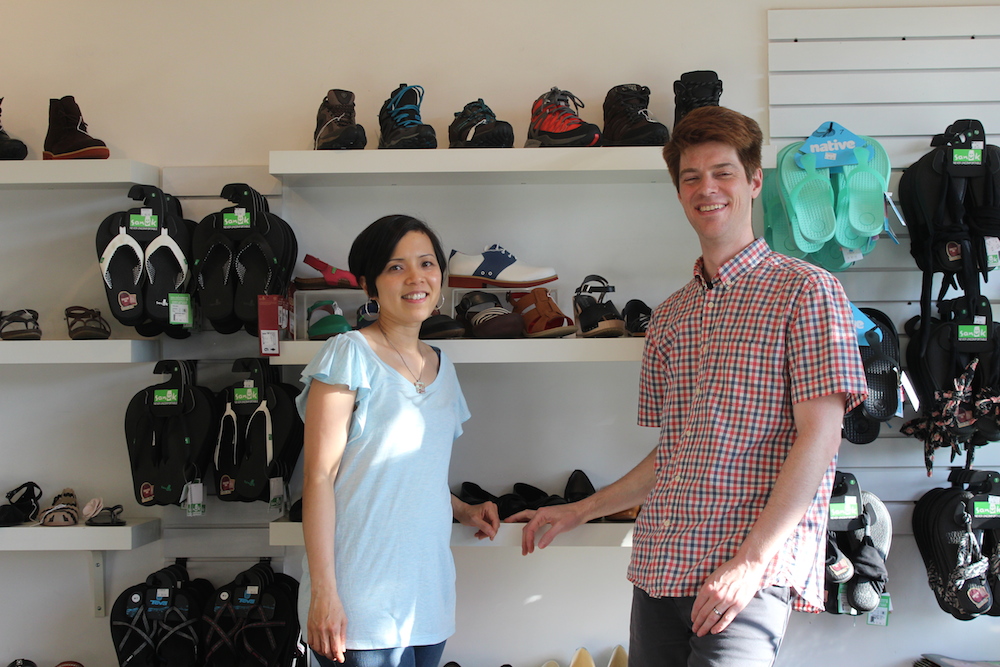
Nice Shoes, Vancouver’s only vegan shoe store, was opened in 2011 by animal advocates Glenn Gaetz and Joanne Chang. The store carries 100% vegan shoes as well as purses, bags, belts, wallets and other cruelty-free products.
VHS supports the growth of cruelty-free businesses and we were interested to find out more about how Nice Shoes is faring in Vancouver’s competitive retail market. Here’s our Q&A with Glenn and Joanne.
.
VHS: Can you say a bit about what motivated you to open Nice Shoes?
G&J: As shoppers, we were motivated by the anxiety and frustration we felt every time we walked into a shoe store knowing that the salesperson couldn’t answer our questions about materials – or even cared to try. As activists, we were motivated by our desire to normalize the vegan lifestyle.
VHS: How difficult was it to start a business that was the first of its kind in Vancouver?
G&J: Starting a business was the easy part! Vancouver has a vibrant vegan and animal rights community and everyone is excited when a new vegan business opens. The challenge comes in maintaining a profitable business and growing our customer base.
VHS: How is the business going now and how do you feel about the future of Nice Shoes?
G&J: We think there’s a bright future for Nice Shoes as veganism seem to be going through a growth spurt. We know this because a large portion of our customers are new vegans who have only made the transition within the last couple of years.
VHS: Who are your customers? Is there a predominant demographic?
G&J: Our main customers are vegans and vegetarians, but that in itself encompasses a huge range of people. We see vegans of all ages and professions. We also get quite a few non-veg customers who simply like the styles we carry.
VHS: Some vegan shoes are not cheap. Is affordability an issue?
G&J: Since our main goal is to normalize veganism, we are very thoughtful in selecting brands that are familiar and affordable to most people. We do carry some exclusive vegan brands (which tend to be pricier), but they are a small percentage of what we carry. Most of the shoes in our current spring/summer collection range from $30-$150. We also have great sales throughout the year and a student discount program.
VHS: Do you think the market is growing for cruelty-free products?
G&J: Absolutely! We find that “vegan leather” is now a popular term used proudly by mainstream brands to sell products. And a lot of these brands are rolling out vegan product lines and marketing them as such.
VHS: What do you think needs to happen to encourage consumers to make more ethical choices?
G&J: Consumers want nice looking things that are decent quality at a reasonable price. If the products can match what they are looking for, they will switch without even trying. We have a few loyal non-veg customers who might not even know that our products are vegan. By offering alternatives that look great and are equal to, if not better than, their animal product counterparts, we are lowering the barrier of entry to a vegan lifestyle. All things being equal, who wouldn’t choose the cruelty-free option?
VHS: How do you stay positive in a world where animal-based products are still so predominant?
G&J: We’ve been vegan for 18 & 20 years. In that time we’ve seen a lot of change. Twenty years ago, vegan shoes were horrible plastic things that looked atrocious and felt like cardboard. When we look at the selection and the quality of products available nowadays, we can’t help but smile. Animal products may still be predominant, but the alternatives are gaining ground every day.
VHS: What’s your most popular product?
G&J: Since the weather is getting nicer, women’s sandals are flying off the shelves. And hiking shoes are in high demand as people are starting to hit the trails.
VHS: What do you find most rewarding or satisfying about running Nice Shoes?
G&J: Nothing makes us happier than getting a positive feedback from our customers – it really makes all the hard work worth while. And of course, all the adorable dogs who visit us in the store.
Nice Shoes is located at 3568 Fraser Street (between E 19th & 20th) in Vancouver. Tel: 604-558-3000 info@niceshoes.ca
This April, Langley’s Trinity Western University became the second school in Western Canada to join the globally popular Meatless Monday movement. Trinity Western follows Langara College in encouraging students to start the week right by choosing veg meals each Monday.
VHS worked with Trinity Western students and food services personnel to implement Meatless Monday as an easy, positive way for students to make a meaningful difference for the planet, for our health, and of course, for animals.
Trinity Western advertises that “Each Monday, Dining will be presenting ‘plant based’ dinner menus that are not only good for your health but are also GREAT for the environment!”
Meatless Mondays are also great for animals. Our overconsumption of cheap meat has forced animals into factory farms, where they endure intensive confinement, mutilations without painkillers, crippling deformities, and terrifying slaughter—all in the name of profit.
TWU promotes Meatless Monday
If all Canadians went meatless on Mondays, more than 100 million animals would be spared from a miserable life and death in our country’s factory farms.
And research reveals that showing people how to go vegetarian can be even more important than showing them why. Students who are exposed to meatless meals learn that vegetarian cuisine is varied, diverse, filling, and delicious, and may be inspired to choose veg options more frequently—sparing even more animals from cruel factory farms.
To learn more about bringing Meatless Monday to your school or company, please contact us. We can send a speaker or workshop facilitator, provide you with resources, or simply offer guidance.
“I always wondered why somebody doesn’t do something about that. Then I realized I was somebody.” – Lily Tomlin
Next Monday, March 30th, Langara College will become the first campus in Western Canada to adopt the popular Meatless Monday initiative, joining hundreds of schools worldwide including McGill, Dalhousie, and Queen’s, along with Columbia, Johns Hopkins, and U.C. Berkeley.
The initiative was introduced by Langara’s food services provider, Chartwells—which is owned by Compass Group, one of the largest food services providers in the world—in response to student demand and in collaboration with the Vancouver Humane Society (VHS).
Meatless Monday is an international movement of schools, hospitals, municipalities, companies, and families that choose to ditch meat each Monday in favour of healthy, delicious, humane, and eco-friendly vegetarian options.
“Meatless Monday is an incredibly popular initiative that resonates with people from all walks of life because it is an easy, positive way for each of us to make a meaningful difference for animals, our health, and the planet,” said Anna Pippus, special projects director for the VHS. “Our over-consumption of cheap meat has forced animals into factory farms, where they endure conditions and practices that most Canadians find appalling.”
“The Vancouver Humane Society commends Chartwells at Langara for responding to student concerns about the impact our food choices have on the world. Chartwells has demonstrated industry leadership in putting Meatless Monday on the menu,” she said.
Facts:
In 2014, 725 million animals were killed for food in Canada. Canadians eat almost 100 kg of meat per capita per year. The global average is less than 40 kg per capita.
According to Dietitians of Canada, plant-based eating has many health benefits, including lower rates of obesity, heart disease, high blood pressure, high blood cholesterol, type 2 diabetes and certain types of cancer.
Due to livestock farming’s inefficiencies, it is a major contributor to climate change, pollution, water use, land degradation and deforestation, biodiversity decline, and ocean degradation, sparking criticism from the United Nations and Chatham House, among many others.
Back in 2008, VHS had an opinion piece published in the Globe & Mail, calling for a reduction in meat consumption for animal welfare, environmental and health reasons.
At the time, we weren’t hopeful that governments, mainstream media or other power brokers were likely to take the issue seriously, despite the overwhelming evidence of the problems caused by meat production and consumption.
But last week, there was a hopeful sign of change when the foremost nutrition advisory panel in the United States officially called for Americans to eat less meat to protect their health and the environment. (Animal welfare is not in the panel’s mandate, but its advice, if heeded, would likely save many animals from suffering and slaughter on factory farms across the U.S.)
Another welcome sign of the times was an amazing article in the Globe & Mail this week by nutritionist Leslie Beck. Quoting celebrated Canadian scientist Dr. David Jenkins, the article laid out the compelling reasons why a vegan diet benefits human health, the environment and animal welfare.
So far, there is no indication that Health Canada, which produces Canada’s Food Guide, will follow the U.S. example of recommending a cut in meat consumption. But with more articles like Leslie Beck’s it may only be a matter of time before Canada catches up.
See our our Eat Less Meat page for more information on this issue.
Luxton Rodeo calls it quits after campaign by VHS and VCARE
The Luxton Rodeo in Langford, B.C. has been cancelled, following a three-year campaign by the Vancouver Humane Society (VHS) and Victoria Citizens Against Rodeo Events (VCARE).
The campaign,which gained support from local people in Langford and from animal lovers across the country, had called for an end to cruel rodeo events. Powerful newspaper ads, like the one shown at left, helped raise public awareness about rodeo animal cruelty. VHS would like to thank everyone who supported this effort – this is your victory.
The demise of Luxton is another sign that British Columbians are turning against the cruelty of rodeo. A 2013 public opinion poll by Insights West found that 56% of B.C. residents are opposed to rodeos, with only 38% in favour of them. On Vancouver Island, 63% were opposed to rodeos.
The cancellation of the Luxton Rodeo is the second blow to the rodeo industry in recent years. In 2007, after a long campaign by VHS, the Cloverdale Rodeo announced that it would discontinue four key events: calf-roping, steer-wrestling, team-roping and wild cow milking. VHS also convinced the City of Vancouver to ban rodeos in 2006.
VHS will continue its fight to end rodeo cruelty, including our campaign calling on the Calgary Stampede to drop calf-roping and to suspend its chuckwagon race.
Please join us in our effort to end the suffering of rodeo animals. With your help we will gain more victories for compassion and civilized behaviour toward animals.
According to a recent Globe & Mail article, vegan cuisine has moved into the mainstream. Certainly, no one can fail to notice the emergence of vegan and vegetarian restaurants (along with more meat-free options in conventional restaurants) and the availability of meat and dairy substitutes in supermarkets. While the overwhelming majority of people are still carnivores, adopting a plant-based diet is no longer on the freakish fringe of lifestyle choices.
Using Google books Ngram Viewer, a digital tool that can track the historical frequency of words in a database of about six million books, it’s possible to see how the concept of meatless diets has advanced in our culture in recent decades. The charts below are roughly indicative, tracking several relevant terms:
Although “vegetarian” appears to dip after 2000:
Rising concerns about the impact of meat consumption on animal welfare, the environment and health have no doubt played a role in increased public interest in plant-based diets. But despite this trend, global consumption of meat is accelerating because of increased demand in Asia.
Animal activists, environmentalists and health advocates promoting lower meat consumption have their work cut out for them.
VHS is committed to encouraging a plant-based diet and lower meat consumption to help end factory farm cruelty and reduce animal suffering and slaughter.






 This April, Langley’s Trinity Western University became the second school in Western Canada to join the globally popular