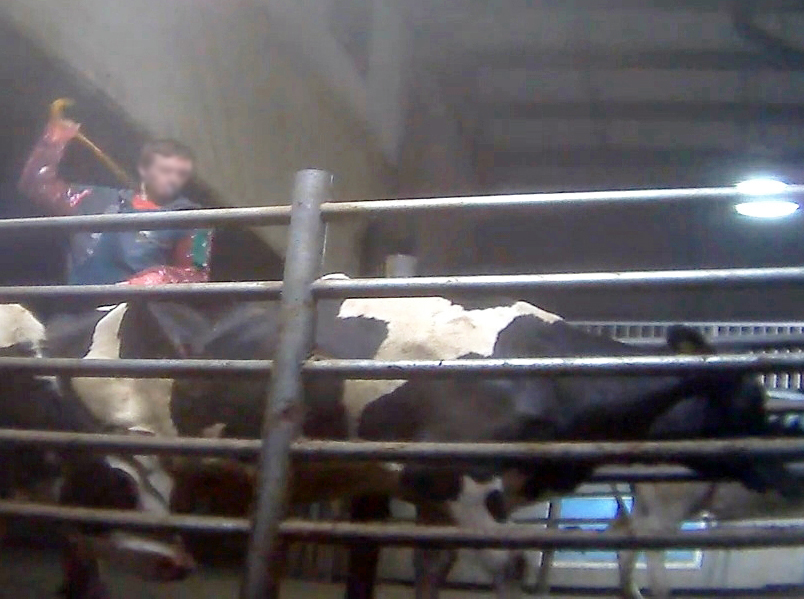
It has now been one year since the BC SPCA recommended criminal animal cruelty charges against eight employees at Chilliwack Cattle Sales, Canada’s largest dairy producer, and many months since provincial animal cruelty charges were recommended against the company itself. Yet, Crown prosecutors have still yet to come to a decision about laying charges.
For its part, the BC SPCA responded quickly, conducting a raid on the facility and recommending animal cruelty charges within days of receiving video and written evidence covertly obtained by an employee over the course of four weeks last spring.
The delay is unusual and concerning. Prosecutors have been presented with incontrovertible evidence of animals being routinely whipped, kicked, and punched in their faces, bodies, and testicles. Still more animals were documented on video suffering from untreated gruesome injuries and infections.
Internationally respected bovine expert and veterinarian Dr. James Reynolds commented that the video depicted “the most severe cases of animal abuse I have ever seen in 32 years.”
Worse, the company itself appears to have been complicit in the abuse and neglect, despite attempting to distance itself from the employees during the public outcry that followed the footage’s release. The whistleblower stated that he repeatedly brought his concerns to management, which failed to act; several more fired employees came forward to say that they were unfairly taking the fall for a company that created and condoned the apparent widespread culture of cruelty.
Yet, Chilliwack Cattle Sales continues to operate with impunity, milking a staggering 3500 cows three times each day.
It did not take long for the BC Milk Marketing Board to act. By last September, the regulator had made the standards in the national dairy code of practice mandatory, effective virtually immediately. Such actions by provincial regulators are all the more important in Canada’s supply-managed dairy industry, where milk is pooled and dairy processors cannot set animal welfare standards for their suppliers—a tactic commonly used in other countries.
This case presented a unique opportunity for prosecutors to take farmed animal cruelty as seriously as it ought to be. We killed 740 million animals for food in 2014, making farmed animals by far the largest population of animals under human care (by contrast, there are about 15 million pets in Canada). However, these pigs, chickens, turkeys, and cows are kept largely in windowless sheds on private property, entirely shielded from the scrutiny of law enforcement, which is unable to inspect farms without first receiving a complaint from the public.
Unsurprisingly, on the rare occasion that complaints about farmed animal cruelty are received, they come from neighbours concerned about neglect on small operations, where animals may be visible. Employees at factory farms are unlikely to report abuse when their livelihood is at stake, or when they may be reporting on their friends—or themselves.
In the case of Chilliwack Cattle Sales, however, not only was an employee able to obtain evidence of illegal animal cruelty, he was able to actually document malicious abuses while they were being committed, rather than simply after-the-fact conditions of neglect.
Although animal cruelty laws in this country are regularly criticized for being weak, the reality is that provincial and federal law are clear that animal abuse and neglect are illegal. National codes of practice, created with government funding, set standards of care that arguably form a part of the law.
However, these laws are meaningless without adequate enforcement. Barriers to enforcement admittedly do exist—farmed animals are out of sight, law enforcement only acts in response to public complaints, and cruelty laws are mostly enforced by private bodies that are underfunded (the BC SPCA, for example, receives no government funding and must fundraise for all of its operating expenses, from sheltering animals to investigating cruelty).
But when a robust file of evidence virtually falls into prosecutors’ laps along with charge recommendations from law enforcement, farmed animals at last have an opportunity for swift justice.
Let’s hope the concerning one-year delay ultimately results in meaningful prosecutorial action against Chilliwack Cattle Sales. Anything less sends the message that illegal animal cruelty is a permitted ingredient in Canada’s food supply.