Categories
compassion Cruelty-free fundraising News/Blog Promoted Scotiabank Uncategorized

Meet the VHS team!

.


New video gives a behind-the-scenes look at VHS

VHS celebrated its 30th anniversary last year and we’re proud of our history. But we’re focused on the future and working hard to make life better for animals in the years ahead.

Meet the people at VHS who are taking this work forward in this new video:


Help us continue this important work for animals now and into the future by sponsoring Team VHS in the upcoming Scotiabank Vancouver Half-Marathon & 5k! On Sunday, June 26th, VHS will be participating for our 6th year in the run. It’s our most important fundraiser of the year and we rely on our supporters to help us make it the most successful. Please help us reach our goal by sponsoring our team. We’re 86% of the way there, with 5 days left!

Categories
compassion Cruelty-free Food and Drink News/Blog Promoted vegan vegetarianism

Vancouver’s Vegan Supply supports “a life without animal products”

vsup-basket1

.


Vegan Supply logo website-headingVancouver-based Vegan Supply is a growing business dedicated to ensuring vegan products are available to compassionate consumers. Though focused on the Canadian market, they can deliver anywhere in the world. We asked the company’s Dave Shishkoff some questions about Vegan Supply’s values, challenges and vision for the future.

.


What is Vegan Supply’s mission?

Our primary goal at Vegan Supply is to better the food supply! By selling vegan foods, and ONLY vegan foods, we’re giving people a place to shop at, and invest into, that mirrors their beliefs and ethics. Instead of helping subsidize a grocery store meat department, or worse, greenwashing animal products with nearly meaningless ‘humane’ or ‘cage-free’ labels, we’re providing a legitimately and consistently ethical model. We see every purchase as a ‘vote’, and we’re offering a much higher standard for people to direct their money to, and enable businesses that are really working for a better world.


What was the initial reaction to Vegan Supply’s launch?

Our first public appearance was the 2015 Veg Expo, and it was incredible! Our booth was packed the entire time, and we couldn’t keep up with sampling and sales. This year, we doubled how many people we had, and it was even busier!

We launched our online site shortly after, in May 2015, with some ‘beta’ testing for locals, and we worked out most of our kinks, and have been fully operational since last summer.


What are the biggest obstacles facing the business?

While Vancouver residents can take advantage of our ‘drop-off’ option at either Meet restaurants (orders can be picked-up free), the lack of inexpensive shipping in Canada is probably one of the most challenging issues we’re confronted with. We’re already ‘topped out’ with Canada Post’s value options, and while it’s not too bad ordering non-refrigerated items, which aren’t any rush, it can be a fair bit to order refrigerated goods in 2-3 days to the other side of the country like Newfoundland.

We’re also finding a lot of vegans don’t participate in what we’d consider ‘common’ vegan online venues – despite a fairly visible presence in the local Facebook groups, and all the other social media exposure we’ve had, there are still a lot of local people who are surprised to find us (many at Veg Expo for example!) We’re a very diverse group, and it’s hard to be visible to ‘most’ vegans!


How do Vegan Supply staff stay positive in a world where animal-based products are still so predominant?

This isn’t actually an issue at all; it’s really empowering since we’re not dealing with these at all, and are actually confronting and replacing animal products. Plus we have the best customers who are enthused to not have to deal with these issues either. It’s not often a someone can shop and not worry about looking at a single ingredient list!


What are the most popular products?

Our biggest draw would have to be Miyoko’s cheeses – and they really are incredible. Unlike other vegan cheeses we’re used to, these are actually cultured nut-based cheeses, with an incredibly rich flavour and experience. As Miyoko herself puts it, it’s not the cow’s milk that makes cheeses taste so diverse, it’s the bacteria cultures that are used. Think about it – the ‘same’ milk is used for all traditional cheeses! These taste experiences can be had without harming animals, and Miyoko’s is really strong evidence of this.

Other top sellers include our diverse range of cheeses and spreads, like Vtopian, Sheese and Fauxmage; vegan jerkys (Louisville, Primal Strips and Butler are always winners); caramels from Cocomels and Liefie’s; and of course more familiar brands like Earth Island, Daiya, Gardein and Field Roast.


Who are your customers? Is there a predominant demographic?

Vancouver is obviously our biggest market, and we ship quite a bit to Alberta and Ontario. We’ve shipped to every province now, and I believe Nunavut is the only Territory that we haven’t shipped to – hopefully we can change that soon!

As far as individuals, we suspect a big part of our demographic is vegans, but also vegetarians, those looking to go vegan, and those who want or have to avoid animal products, like those who are lactose intolerant or allergic to eggs or other animal products.


What do you think is the best way to encourage consumers to make more ethical choices?

I think the most important step is making sure they know there is ‘life without animal products’. Once people know that they can live pretty ‘normal’ lives and that really great vegan offerings exist, the transition becomes much easier. We can live without exploiting and harming animals, and hopefully companies like Vegan Supply are making it much easier for people to do this. If someone is wondering ‘what do I eat as a vegan’, we’ve got nearly one thousand (and growing!) items to choose from – there’s no shortage!


Do you think plant-based products and businesses are becoming more mainstream?

They’re definitely infiltrating the mainstream. People commonly plan to ‘go eat vegan tonight’, and every week there are news stories highlighting how much better off we are by reducing and eliminating animal products in our lives, from our own health to the health of the planet, and of course the animals themselves – it’s definitely more visible than it’s ever been.

In Vancouver, we’re seeing more and more places expanding their vegan offerings, from restaurants to grocery stores. It was pretty slim picking 20 years ago, and few places even offered soy milk. Now, every grocery will have it (even some convenience stores!), in addition to vegan meat alternatives, ice cream, and usually much more!


What are some of the lessons you’ve learned about running a vegan business?

Ha! Don’t start a shipping-based business in Canada. *wink* How people access the site is also intriguing – for example we have several reminders along the process to include cold packs, but sometimes people still don’t order them…so we still need to figure out how to better communicate this sort of thing! It’s almost comedic if you actually read what’s on the site, and how much we’ve tried to inject this message in the process.

On a more serious note, we’ve learned that there are a lot of amazing people out there, who share our vision, and want to see a better world, and are helping us better the status quo – thank you so much to those people!!

Categories
animal welfare compassion cruelty News/Blog Promoted rodeo

Why is animal lover Jann Arden promoting the Calgary Stampede?

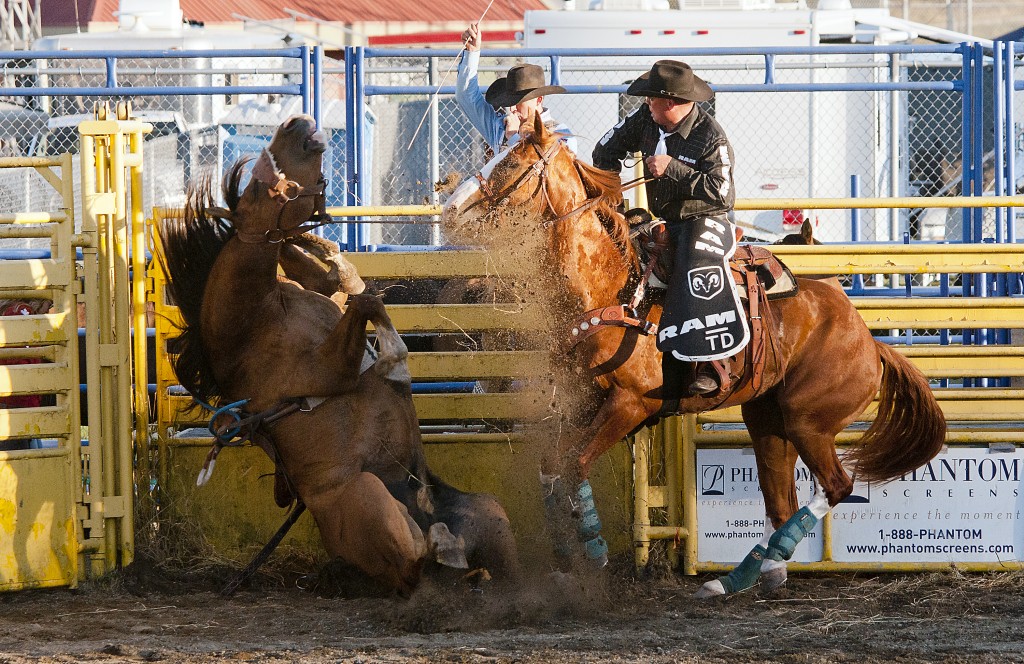
Bucking horse at Calgary Stampede. Photo: Jo-Anne McArthur

Let Jann Arden know that rodeo is cruel – see actions below.

Singer Jann Arden, long known as an animal lover, has been named as a joint-parade marshall for the Calgary Stampede parade, the event that kicks off the ten-day rodeo, fair and chuckwagon races.

The announcement is a surprise, given Arden’s previously stated opposition to the chuckwagon races, shown in this tweet from 2013:

J Arden tweet against chuckwagon race

Presumably, she is aware of the 65 horses that have died in the Stampede’s chuckwagon races since 1986? That includes 11 dead horses since the Stampede’s much-publicised new “safety measures” were implemented in 2011.

Arden’s decision is also surprising and disappointing given her support for animal causes, including opposition to the Alberta government’s cull of wild horses. Perhaps she isn’t aware that the Calgary Stampede also culls unwanted horses, as revealed by media in 2012.  As CTV News reported at the time, “For the first time, the Calgary Stampede is admitting that horses that don’t make the cut to compete in the famous rodeo are sent to an Alberta slaughterhouse for meat.”

In 2014, Arden described her opposition to the Alberta horse cull and her feelings about horses, stating:  “They just need to be treated with respect. I know there needs to be some sensibility, but why does the fucking solution have to always be killing something?”  Yet killing is the Stampede’s solution to unwanted bucking horses. Isn’t there a double-standard here?

Perhaps Arden is not aware of Stampede’s horse culling policy but is she also unaware of what happens to other rodeo animals?

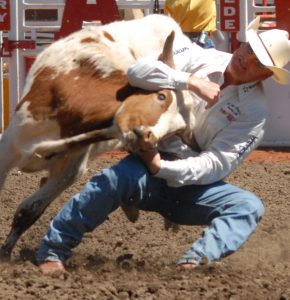
DSC_0021Does she know that steers died in the Stampede rodeo’s steer-wrestling event in 2014 and 2013?
Steer-wrestling involves riders jumping onto steers and twisting their necks until they fall to the ground.  Both steers had to be euthanized because of neck injuries.

Steer-wrestling has nothing to do with real ranch work. It was invented for rodeo in the 1930s.  It’s just entertainment.

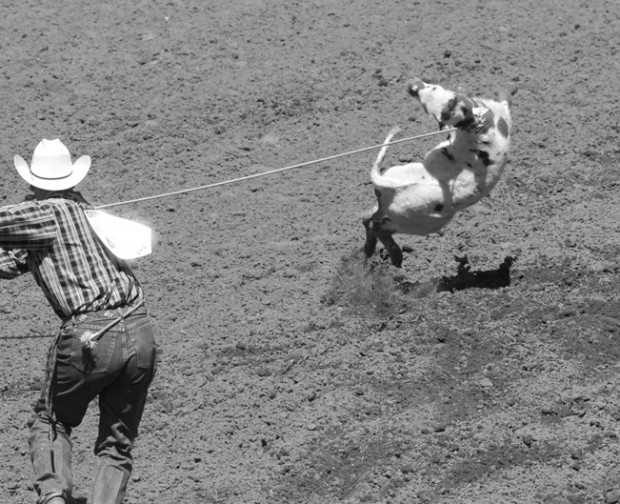
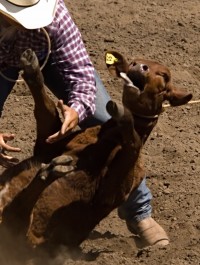
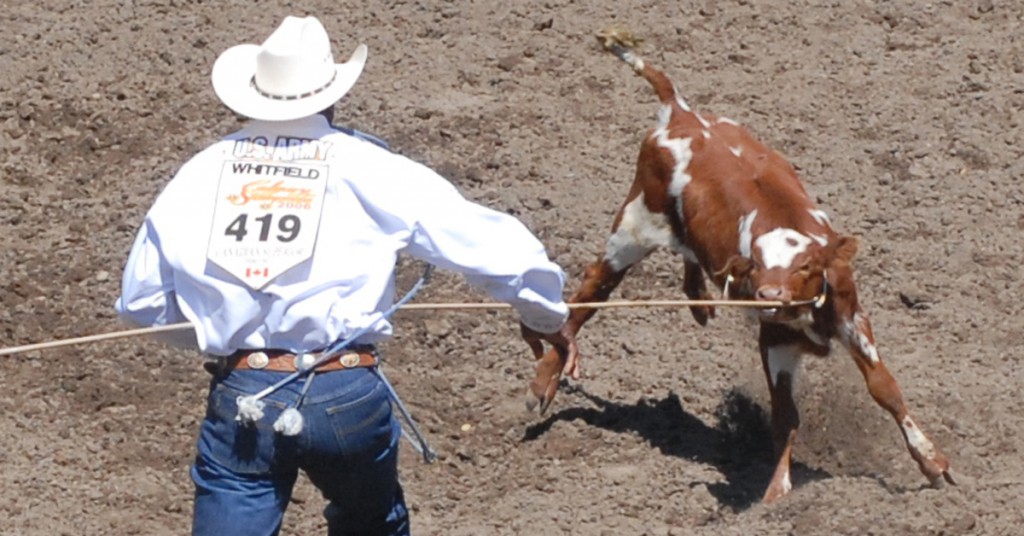
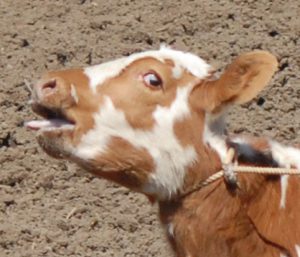
Perhaps Arden is unaware of the suffering of other rodeo animals such as the three-month-old calves that are chased, roped, thrown to the ground and tied up. Or the steers that are roped by the horns and hind legs and stretched off their feet. Or the bulls and bucking horses that are tormented into bucking by the flank strap tightened around their hindquarters.  And all these animals suffer for the mere amusement of a crowd.

Ad calfDoes Arden care that virtually all animal welfare agencies around the world are opposed to rodeos – organizations like the Canadian Federation of Humane Societies and the national SPCAs of the United States, Australia, New Zealand, South Africa and the UK.

And does she care that most of her fellow Canadians are opposed to rodeo, with a recent poll showing that only three-in-ten Canadians are in favour of using animals in rodeos?

Let Jann Arden know that rodeo is cruel

If you think Jann Arden needs to rethink her support of the Calgary Stampede, please let her know.

Below are some actions you can take to send her a message.

You can tweet one of the messages below by clicking on it. (You will need to be logged in to Twitter.):

Tweet: .@jannarden Please don’t support the Calgary Stampede rodeo & chucks. The Stampede culls unwanted bucking horses. Rodeo animals suffer!

Tweet: .@jannarden Surprised you are supporting the Calgary Stampede, which is known for animal cruelty. Please reconsider!

Tweet: .@jannarden As an animal lover aren’t you concerned about the treatment of horses and rodeo animals at Stampede? 65 dead horses since 1986!

Or simply compose your own tweet to her at @jannarden

You can politely comment on Jann Arden’s Facebook page.

Every time you take a stand for the animals it makes a difference.


Categories
animal welfare cruelty News/Blog Promoted rodeo

Why is a convicted wildlife poacher on the board of the Canadian Professional Rodeo Association?

dead steer1 040523Rodeo046
Rodeo isn’t known for its kindness to animals but its board members should be held to some standard of ethical behaviour.

VHS calls for removal of rodeo association board member

.


The Canadian Professional Rodeo Association’s Animal Welfare Guide states that it “supports the responsible and humane use of animals and believes that all animals utilized in entertainment, industry and sport should be afforded proper care and management.”

Presumably, this includes the “sport” of hunting but one of the CPRA’s board directors, Cody Cassidy, doesn’t seem to afford wildlife “proper care and management.”  In fact, Mr. Cassidy pleaded guilty to several poaching-related charges in July of last year, according to the Red Deer Advocate. The charges included hunting without a licence, possession of wildlife and controlled animals, and providing false or misleading information. Mr. Cassidy received a $16,000 fine and a one-year judicial order preventing him from obtaining an outfitting-guide permit.

The presiding judge at Red Deer Provincial Court cited Mr. Cassidy’s history of these types of offences, including guiding on private property without permission, failing to post signs in an area of black bear bait, unauthorized hunting and discharging a firearm on private property without permission.

Mr. Cassidy’s father Greg, a champion steer-wrestler also pleaded guilty to poaching charges in the same case. He was inducted into the Canadian Pro Rodeo Hall of Fame just months later.

Cody Cassidy operates Big Knife outfitters, which takes clients on moose hunts. His father Greg volunteers with the company. The Red Deer Advocate’s account of the court case includes a description of the hunt, which aside from the poaching offences, raises concerns about the hunt itself. It states: “Greg and the client were hunting at one of the Central Alberta locations when they spotted a moose.The client shot the moose with one arrow, which did not kill the moose. Cody joined the hunt and they tracked the moose for three hours. When they caught up with the moose, they shot it with a few more arrows, killing it.” It is difficult to see how this animal could not have suffered during the three hours after it was wounded.

VHS has written to CPRA president Murry Milan, calling for Mr. Cassidy to be removed from the board. The letter states: “Clearly, these are serious offences for someone in a position of responsibility at the CPRA, who should be held to the highest ethical standards.  We find it unacceptable that Mr. Cassidy remains as director on the CPRA board.”

The CPRA can be contacted at cpra@rodeocanada.com


Categories
animal welfare compassion Food and Drink News/Blog plant-based diet Promoted vegan vegetarianism

Help the world go veg with our amazing bumper stickers!

Debra promotes veg bumper stickers 2
VHS executive director Debra Probert LOVES our new bumper stickers!

We’ve got two great bumper stickers you can use to support our efforts to promote a plant-based diet.

The stickers, which can be ordered on our merchandise page, promote our Meatless Monday and Go Veg campaigns. They cost $1.50 each, or $2.00 each with a magnet.

Here’s what they look like up close:

.

GoVeg_black_carrot

VHS-MM-Bumper-Stickers-2015-WEB

.

You can also order our FREE veg booklet and Meatless Monday brochure by emailing Emily at emily@vancouverhumanesociety.bc.ca

VHS Veg Booklet - 2015 Cover-page-0small

MM brochure cover Capture

.

.

.

.

.

.

.

.

.

.

.

.

.

Categories
animal welfare cruelty News/Blog Promoted rodeo

CBC to broadcast rodeo cruelty again

Calf roping 05

CBC Sports is once again planning to broadcast the rodeo and chuckwagon races at the Calgary Stampede.

CBC continues to ignore the fact that a majority of Canadians are opposed to using animals in rodeos, as shown in recent polls.  Our national public broadcaster is supposed to reflect Canadian values.  Instead, it persists in broadcasting events that subject animals to fear, pain, stress and the undue risk of injury and death – all for the sake of entertainment.

If you haven’t already done so, please sign our petition.

DSC_0345
Photo: Jo-Anne McArthur


Categories
animal welfare News/Blog Promoted

Fort McMurray fire – animal rescue

Dog cat iStock_000025076373Large

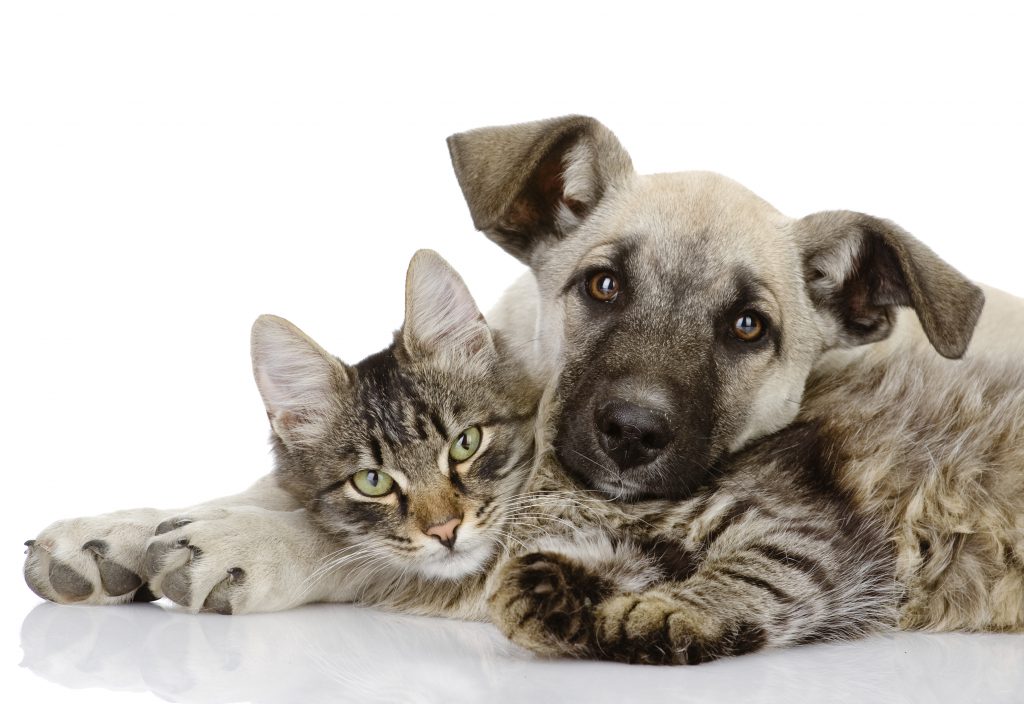
The fire and evacuation in Fort McMurray is, of course, having an impact on animals.

If you would like to help, donations can be made to the Fort McMurray SPCA along with the Alberta Spay Neuter Task Force, which are helping to coordinate an effort to keep pets and livestock with their families.

VHS has donated to each of these groups, whose efforts we appreciate in this challenging emergency. Our thoughts are with the people and animals who have had to leave their homes.

Categories
animal welfare compassion cruelty News/Blog Promoted rodeo

Why is the UBC alumni association promoting the Calgary Stampede’s cruel rodeo events?


DSC_0382
Calf-roping at the Calgary Stampede. Photo: Jo-Anne McArthur


It’s surprising and disappointing to learn that the University of British Columbia’s alumni association, Alumni UBC, is offering a trip to the Calgary Stampede rodeo to its members. It’s disappointing for obvious reasons – animals shouldn’t suffer for the sake of entertainment – but surprising because universities and their wider communities are often the agents of progressive social change.

calf roping040522Rodeo082cropresize

A number of UBC’s alumni who are associated with VHS (directors, former directors, staff) signed a letter to the association last year, urging an end to the promotion, but it’s being offered again this year.

Presumably, Alumni UBC sees nothing wrong with tormenting animals.  Perhaps they find the photos on this page perfectly acceptable.  Most likely, they just see the Stampede as a tradition and see no reason to challenge it.

It’s a shame that when this issue was brought to the association’s attention, no one there had the intellectual curiosity to ask some questions about the ethics of rodeo.

Questions like this: When does an accepted tradition become unethical?

Sometimes you can put a date on it. Dog fighting, bear baiting, and bull baiting were outlawed in England by the Cruelty to Animals Act of 1835. But that doesn’t tell us when the critical mass was reached that allowed that change to take place. When did watching animals tear each other apart go from crowd-pleasing fun to socially unacceptable?

It’s even more difficult to determine when we’re approaching that critical mass on an issue in our own time. But sometimes there are clear signs.

VHS has been campaigning against cruelty to rodeo animals for a long time.  It’s still popular in a number of Canadian towns and, of course, at the Stampede. Nevertheless, cracks are appearing in public support for rodeo.

Calf roper at 2006 Russian River Rodeo, Duncans Mills, California

The most obvious indicators are polls showing most Canadians don’t support rodeos.  A December 2015 survey by polling company Insights West found that 63 per cent of Canadians are opposed to using animals in rodeos (66% in BC). Does Alumni UBC care that they are promoting something most Canadians think is wrong?

But polls are not the whole story. The cancellation of two professional rodeos in B.C. in the last two years (and half the events at Surrey’s Cloverdale Rodeo in 2007) signal a real lack of public support for rodeo on the West Coast. It’s no wonder the City of Vancouver banned rodeos in 2006.

Last year, the Vancouver Sun became the first daily newspaper in Canada to take an official editorial stance opposing rodeo.

In the same month, six other independent opinion editorials questioned the ethics of rodeo, including a piece by a member of the Calgary Herald’s editorial board, who wrote: “…the bottom line is these animals are still being used for sheer entertainment in events that can cause them traumatic injuries and death — and it is unnecessary for them to be subjected to this. Are we humans so hard up for entertainment that we must amuse ourselves by watching events that can cause animals to suffer and die?”

Most mainstream animal welfare organizations are opposed to rodeos, including our own BC SPCA, the Canadian Federation of Humane Societies and the national SPCAs of the United States, Australia, South Africa, the United Kingdom and New Zealand.

These are the institutions we entrust with the protection of animals and they think rodeo is inhumane. So do most British Columbians. So do most Canadians. So does the City of Vancouver. But not, apparently, Alumni UBC.

Back in 1835, there were few institutions to fight for the welfare of animals. But the compassion of enlightened Christian reformers brought about the critical mass necessary for profound change.

Today, our animal welfare organizations have made the case against rodeo. Now we need people of conscience, community leaders, educational institutions and civic organizations to recognize that it’s wrong to make animals suffer for the sake of human amusement.  Shouldn’t the alumni association of one Canada’s best universities be among them?

Please send a polite email to Alumni UBC asking them to stop promoting the Calgary Stampede rodeo.

More about rodeo here.


Ad calf
Photo: Jo-Anne McArthur
DSC_0345
Photo: Jo-Anne McArthur
Calf roping Cal Stamp J Mc
Photo: Jo-Anne McArthur

Calf being viciously roped at Calgary Stampede

JMDSC_0073crsmall

Wild cow milkingRodeo2

080802-Rodeo371

Bareback Riding

Calf face crop Rodeo-99


073115 - Abbotsford, BC Chung Chow photo 2015 Agrifair Rodeo in Abbotsford. Bronco riding Bronco refused to get up until motivated by the cowboy behind the fence.

Categories
animal welfare compassion Cruelty-free Food and Drink News/Blog plant-based diet Promoted vegan vegetarianism

Erin Ireland’s plant-based journey

BMlW8PsCAAAuwwG

Erin Ireland is a food journalist, blogger, entrepeneur and animal-lover who has been on a personal journey to discover and understand the principles and practices involved in ethical eating. In a recent blog post (reprinted below with her kind permission) she describes her transition to a plant-based diet.  


It’s Sunday morning and I’m sitting here on the couch in pyjamas drinking an almond milk latte. I’m crying after re-reading some of the 831 comments on Jillian Harris’ blog post, “How This Alberta Meatatarian Became so Vegan-ish”, in which she opens up about her transition to a plant-based diet.

In the days following her post, I texted Jillian to say how impressed I was by her written words—how I envied her ability to get thoughts ‘on paper’ so effortlessly. What she wrote would have taken me months. She has drawn me to my computer today to share the unedited story of my own journey. I usually stick to sharing my ‘plant-based messages’ on social channels because they are short and easy to write. I definitely prefer talking over writing, which is why I gave this speech. But Jillian’s post (which broke jillianharris.com website traffic records) inspired me to go deeper and share some of the factors the inspired my personal decision to go vegan.

Like Jillian, I used to be a ‘meatatarian’. I was proud of it. As a college athlete training twice a day, I was the type to order double meat at Subway. I thought eating nothing but ‘lean animal protein’ would help me achieve a healthier, more fit, muscular body. I often said that I was “just not the type who would ever become a vegetarian”.

Wow, how things have changed…


WHAT DOES “VEGAN” MEAN?

My introduction to the word vegan came when I asked my parents what the term meant. My memory is a bit fuzzy, but I believe they alluded to the fact that veganism was some super-extremist lifestyle that was more-or-less unachievable and mainly adopted by ‘extreme hippies’. I never thought twice about learning more.

Looking back, I don’t blame my parents. 25 years ago things were different. Factory farming wasn’t in the media spotlight like it is today. Baby-Boomers were raised in a time when meat and dairy was fully embraced. National meat and dairy councils were (and still are) supplying nutritional information to schools in North America. Despite the conflict of interest, teachers believed what they were teaching and young, impressionable students ate it up, literally.

THE FIRST ANIMAL PRODUCT I REMOVED FROM MY DIET

My first step towards cutting animal products out of my life came during sophomore year of university. For most of my life, I’d felt a little bit stuffed up, as if I had a constant cold. My dad suffered the same symptoms and told me that cutting milk out of his diet seemed to alleviate the stuffiness. I switched to soy milk. Immediately my sinuses felt better and I never went back to milk (note: this isn’t a professional opinion and I’m not saying this can work for you, just that it worked for me). I’ll admit, I still ate cheese and chocolate from time to time …how could I resist? I thought it was worth a bit of congestion.

The other reason I cut milk out of my life was acne. My skin issues began around the age of 19. I often got blemishes after big doses of dairy. Cutting milk out of my diet helped, but it was also a hormonal thing for me—going on the pill was the only thing that finally resolved my skin problems completely. Ironically, at the time my reasons for cutting dairy out had nothing to do with environmental or animal welfare issues. I didn’t know the truth about the lives of so many dairy cows. Today, in my heart, our planet and the animals are the main reasons I am passionate to seek dairy alternatives.

MEAT OBSESSION DURING MY VOLLEYBALL YEARS

As an NCAA Div. 1 volleyball player, I thought I needed a ton of protein. I thought I needed a meat heavy diet. Not a single girl on my volleyball team ate vegetarian—if any teammate, classmate or teacher raised the topic of vegetarianism during my four years of school, I don’t remember it. At my peak, I weighed 155 lbs and was the second strongest female in my athletic department.  Always looking to take things a notch further, I wanted to gain more muscle and I thought eating meat would help. Sometimes for dinner, I’d eat a whole rotisserie chicken. Nothing else. Even worse, my teammates and I would go to the Golden Corral buffet (which my mom nicknamed, ‘the pig trough’) for all-you-can-eat steak.

My small university town in South Carolina revolved around the one Walmart, and I loved going there to buy their cheapest lean ham. Another regular purchase was extra lean ground beef that for Hamburger helper that my roommate and I used to love to make. We thought we were making healthy choices. My mom would sometimes ask if I knew where this meat was coming from. I always dismissed her questions thinking she was being a paranoid mom. I remember telling her that the FDA / governing bodies wouldn’t allow unsafe food on the shelves…was I ever wrong. My mom had been right to question.

THE DOCUMENTARIES THAT GOT ME THINKING

My transition to a plant-based diet slowly started with the documentary, ‘Forks Over Knives’. The movie presented facts that a vegan diet not only stops disease from forming in the body, but actually reverses it. The evidence was convincing to say the least. I started to realize the impact animal-based foods were having on our health. I couldn’t believe this was the first time I was hearing such important information. The more I learned, the fewer animal products I ate.

Earthlings was another documentary that had a huge impact on me. It introduced me to the term, speciesism: the prejudice or bias in favour of the interests of members of one’s own species and against those of members of other species. The documentary is graphic, filled with undercover footage shot inside factory farms and the odd slaughterhouse. I shut my eyes and cried through much of it, but I felt strongly that I needed to know what was going on behind closed doors. How could I make decisions about my food choices unless I knew the consequences of my actions? Now, I had seen those consequences and I simply couldn’t have anything to do with it. Farming is not what it was 100 years ago and the vast majority of the time, animals are not leading the happy lives, as depicted on food labels.

At this point in my life, I was still eating cage-free organic eggs from time to time, and if I was in a dining situation where the only option was seafood, I’d take it. But gradually, as I continued to read and watch, I lost all appetite for anything animal-based, including leather.

WHERE I AM TODAY

Three years into my plant-based journey, there are a couple recurring questions friends and family often ask. The first is which animal product I miss the most? The answer is: none. Since learning the true impact of animal agriculture, my cravings for animal products has completely disappeared. Anyone who knows me can vouch for the fact that I love GOOD food, and today, my plant-based options leave me dreaming about my next meal every single day.

The second question is whether my energy or training has suffered since quitting animal protein. Today, I’m more energetic and satiated than I ever was in university. I’m up at 5:30am for a 10K run about five days a week. I can’t imagine having the energy to do this back in the day — I remember always feeling hungry and tired during my school years. Another important driver for me was learning that the fear of not getting enough protein from plants…is a myth. As long as we consume our daily recommended intake of calories (from whole foods), it’s nearly guaranteed we will also get our daily recommended dose of protein. Our bodies can’t even process extra protein (just like vitamins) so they are eliminated from our systems, into the sewage system.

The last thing I’m often asked, is whether veganism requires more work. Ironically, I find it requires less (less stress too!). It’s really the little things that start to add up: no more racing home to get groceries refrigerated. No more obsessive washing of the cutting board for fear of e-coli or salmonella. No more finicky fat trimming. No more stressing over timing and temperature for the perfect steak, roast, or chicken. No more fear of meaty leftovers going bad if I forget to refrigerate right away.

Remember there’s always a learning curve when transitioning to any new diet. If the thought of vegan meal planning is daunting, know that, unlike generations before us, we are spoiled by the amount of amazing resources out there. For starters…

Before hitting publish I reread the post that inspired this note. Jillian received 831 comments on her blog and Instagram post—almost all filled with love, encouragement and acceptance. They bring tears of happiness to my face when I read them. What’s even more heartening are the actions of her following that I’m certain will be inspired from the conversation she has just begun.

Thanks to leaders like Jillian, a word I associated with ‘extreme hippies’ 25 years ago, is now well on it’s way to becoming a mainstream movement. This gives me so much hope.


Categories
compassion Cruelty-free Dairy Food and Drink News/Blog plant-based diet Promoted vegan vegetarianism

Here’s the scoop on Vancouver’s Nice Vice Creamery

NiceVice_015

Nice Vice is Vancouver’s first ever 0% dairy, plant-based micro creamery, which opened in Yaletown in February. VHS talked recently to owner-operator Chris White about starting up a plant-based business. Here’s our Q&A with him:

.

1. What inspired you to open Nice Vice?

I opened up Nice Vice Creamery after visiting many of the fantastic artisanal ice cream and gelato establishments around the city and never having very many D-F options. When I was making so many different flavours at home, my sons inspired me to open up a dairy-free scoop shop.

2. How have you found the reaction from the community?

Absolutely fantastic! I believed that Vancouver was ready to support a 100% dairy-free, plant-based vice cream shop. I think the awareness of plant-based foods has become much more positive in the last few years.

3. What do you enjoy most about running the business?

I love working the front counter and interacting with people. We have received so much good energy from our patrons you can’t help but feel good behind there.

4. What do you find is the hardest part?

We opened up an ice cream store during the winter,with a new brand, with a new product, and in a new location! We made it as hard as possible to succeed. So, if we can get through this and become profitable then we will achieve success.

5. How do you stay positive in a world where animal-based products are still so predominate?

I focus on how aware society is becoming about the positive aspects of choosing a plant-based product over the negative realities of animal-based products. After all, that is one of the motivating factors behind Nice Vice – the ability to participate in change through positive vibrations of consuming vice cream.

6. What is your most popular menu item?

Besides several of our classics, our Instagram @nicevicecream has our new flavours which regularly sell out within a day or two. (Buzz’d Coffee or Strawberry Lychee anyone?)

7. Who are your customers? Is there a predominate demographic?

When I wrote the marketing plan, I assumed that health conscious females between the age of 15-35 would be our predominate SHUs (Super Heavy Users). However, we have been surprised to see an equal number of male customers as well and, pleasantly, we seem to be catching on in the Asian community where over 70% of that ethnic group is lactose intolerant.

8. What do you think is the best way to encourage consumers to make more ethical choices?

This is a good question. At Nice Vice I tell our employees not to judge anyone for any choices they make. We believe that education and awareness of the ethical benefits of a plant-based diet are being portrayed by documentaries auch as Cowspiracy, Earthlings, and Forks over Knives. When the conversation comes up between a customer as to why I am plant-based, I point the customer to these three documentaries to guide them in their own decision making.

9. Do you think plant-based products and businesses are becoming more mainstream?

Absolutely! Plant-based food products and restaurants are the fastest growing sectors in their respective industries. The shift has happened because there is largely no where else to grow. Just look at Ben & Jerrys and the number of new vegan restaurants that have opened this year in Vancouver alone. We are at the beginning of a monumental shift in consumer choice. And thank God for that!!!

10. What are some of the lessons you’ve learned about running a plant-based business?

You can’t please everybody!! There is a wide variety of knowledge in society and we have experienced different levels of emotions from anger and anxiety to euphoria in our shop. Not everyone will believe in what we are doing as being positive – that is the reality and beauty of living in a free society. The other lesson is that dealing with the government can be challenging and requires patience and perseverance. The residual benefits of business are numerous and exciting! No matter what happens with Nice Vice, I can honestly say, I have never had a such a roller-coaster of emotions with this small business and the period of personal growth has been phenomenal.

Nice Vice Creamery is located at 1022 Mainland Street, Yaletown and is open 12-10 daily.

Tel: 778.379.6423

Email: info@nicevicecream.com