
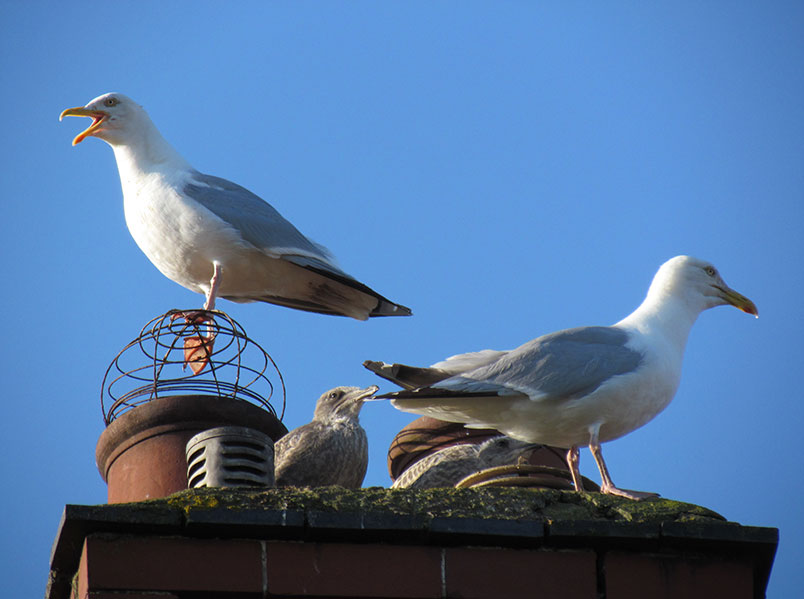
At least that’s what seagulls would tell you if you disturb them right now while they are nesting and hatching their chicks.
This morning, I looked out my window and, on the building next door, I witnessed a maintenance crew disturbing a seagull’s nest with their hoses and safety lines. The gull was frightened and left her nest to circle above, exposing her 3 eggs to the unseasonably cold temperatures.
I went to speak to the crew, taking them a copy of Canada’s Migratory Birds Convention Act, but my comments and handout were mostly disregarded. After about 7 phone calls and emails to various wildlife authorities and to the property management company, the workers finally ceased operations. However, this took over an hour, and without the mother’s body heat to keep her eggs warm, I do not know whether the eggs will hatch next month. Time will tell.
I found out that it is a federal offense to disturb a seagull’s nest, or the nest of any migratory bird. Fines are typically $200 and up, and in some cases as high as $10k.
If you witness a nest disturbance, video or photograph the event and people in question, and contact an Environment Canada Wildlife Officer. In Vancouver, the phone number is 604-314-4789, or email is enviroinfo@ec.gc.ca. That’s what I did this morning, albeit after many calls, emails and google searches to find out who had jurisdiction over the matter. Be persistent!
The important thing to remember is that such conflicts can be avoided. From May to August, seagulls flock to high-rise rooftops to build a nest with their mate and lay their eggs. Unfortunately, this coincides with the same time of year when property managers hire window and power washers to clean their buildings’ exteriors. Alas the conflicts with wildlife begin.
Instead, encourage your Strata Council to plan maintenance activities for times of the year when birds are not nesting – fall, winter and early spring – although property managers should be aware of this already. If you MUST access the rooftop, then give the birds and their nest a wide berth so they remain undisturbed, for their welfare and for your own safety.
Seagulls will return to the same nest site from the previous year, so to prevent a nest next year, remove the old one in January or February before it becomes active. If an active nest MUST be removed, for public or bird safety reasons, call a Wildlife Officer to perform the task as they are the only authorities licensed to do so.
For More information about Environment Canada’s Migratory Birds Convention Act visit http://www.ec.gc.ca/nature/default.asp?lang=En&n=496E2702-1 , and for national contact info, visit http://ec.gc.ca/default.asp?lang=En&n=DA294545-1
Leanne McConnachie
Director, Vancouver Humane Society





 .
.


 When Tucker began vomiting, Lindsey was desperate. Because of her MS, she can only work part-time and that leaves her with little money left at the end of the month. She rushed Tucker to the vet, but she only had enough money to pay for the diagnosis – a severe intestinal blockage. It looked like Tucker had eaten the cuff of a sweater and it was now lodged in his intestine. That was when someone recommended she call VHS.
 While we’re sure Tucker appreciated the help he received during his stay at the vet’s, he’s looking forward to enjoying a safe and peaceful Christmas at home!