Categories
News/Blog Promoted Uncategorized

Thank you for helping animals like Mickey!

Mickey


Mickey is on the mend thanks to VHS donors!

VHS supporters may recall the story of Mickey, who suffered a broken leg and needed expensive surgery.  We’re thrilled to report that VHS supporters stepped up to the plate to ensure Mickey got the help she needed. She’s had successful surgery and is recovering well. Thank you to everyone who contributed to the effort to put Mickey back on her paws!

VHS helps many animals like Mickey through our McVitie Fund for sick and injured animals. Until January 31, 2015 your donation to the fund will be doubled. When you help us, you’re helping animals.

Categories
News/Blog Uncategorized

Can you help Mickey?

Mickey

This is Mickey. Isn’t she beautiful? Mickey was rescued from Hong Kong where, because she is a larger-sized dog, nobody wanted her. Unfortunately, she got away from her guardian (as sometimes happens) and ran out into the street, where she was hit by a car. She broke her right front leg.

Mickey needs expensive surgery so she can run again. Because her guardian is temporarily unemployed, she can’t afford the surgery. We know that our VHS supporters will want to help. The bill is over $500 and thanks to our generous donors we only have $85 left to raise! Remember, right now your donation will be doubled by one of our generous donors. Can you help?

Donate Now Through CanadaHelps.org!

More information on our McVitie Fund for sick and injured animals.

Categories
News/Blog Promoted Uncategorized

Don’t forget sick and injured animals this Christmas

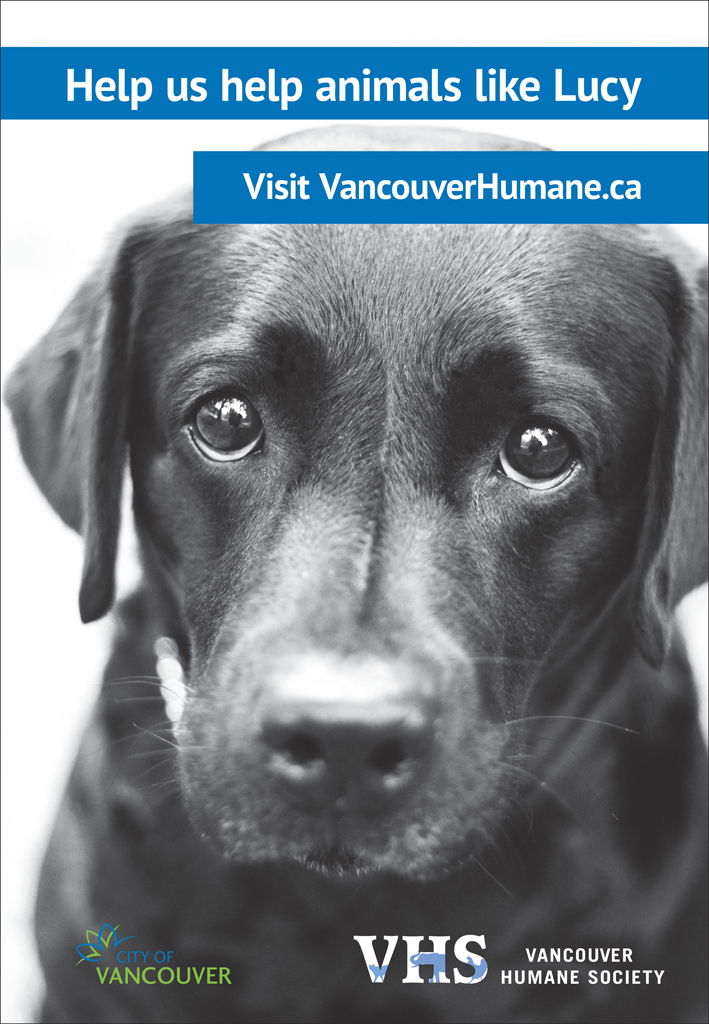
VHS_Transit_Shelter-page-0small

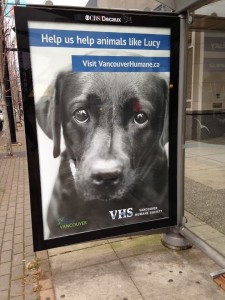
Our new bus shelter ad in Vancouver is a timely reminder that sick and injured animals need your help.

VHS is running the ad until January 5 to seek support for our McVitie Fund for emergency veterinary care.  With your help hundreds of animals will get desperately needed treatment and more will be spayed or neutered.

Donate Now Through CanadaHelps.org!

bus shelter ad


Watch for our ad around town! Thanks to the City of Vancouver for providing ad space and to 24ptHelvetica for design.


.

.

.

.

.


Categories
News/Blog Promoted Uncategorized

Op-ed: Time for Canada to be a plant-protein superpower


Our latest opinion editorial, published online in the Georgia Straight, describes the rise of the plant-based food industry and the opportunity it presents for Canadian agriculture.  It’s a ‘good news’ story – turning to plant-based foods means fewer animals living on factory farms and facing slaughter.

To see more VHS opinion pieces click here.

Categories
News/Blog Uncategorized

Please help animals like Charlie on Giving Tuesday!

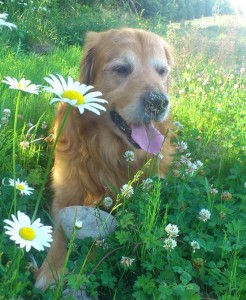
It’s Giving Tuesday, the day Canadians and people around the world give back to their communities and help others.  VHS is asking you to help animals today – Animals like Charlie, pictured left.

Charlie had swallowed a rock, which needed to be surgically removed right away. His guardians didn’t have the money for this expensive surgery, so VHS stepped in to help. Although he nearly died, Charlie pulled through, and this seven-year-old Golden Retriever is now healed and glad to be home.

He’s just one of many animals VHS has helped through our McVitie Fund, which assists animals in desperate need of emergency veterinary care. A wonderful donor has committed to doubling all donations up to $15,000! Please donate $10.00, or any amount you are comfortable with, and then ask your family, friends and co-workers to follow your generous lead in honour of GivingTuesday.

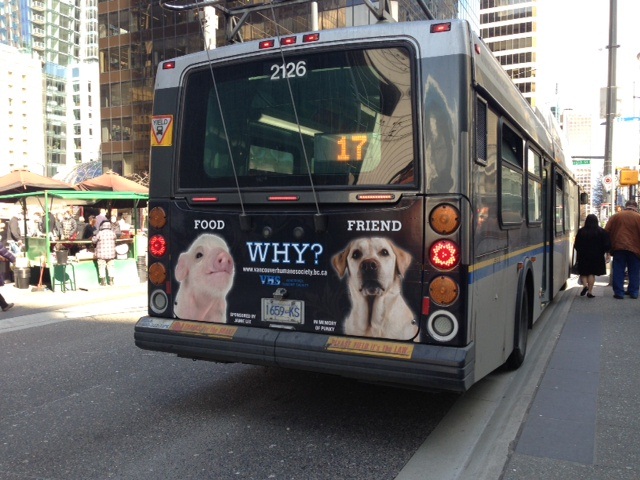
You can also help us run a compelling bus ad posing the question why love one animal but eat the other!

With your help we can save animals today, tomorrow and long into the future!


Categories
News/Blog Uncategorized

VHS news release on chuckwagon incidents

July 8, 2014

Vancouver Humane Society says chuckwagon race fundamentally unsafe
Man injured, horse dead in separate incidents at Calgary Stampede

Vancouver – The Vancouver Humane Society (VHS) says the Calgary Stampede should suspend its chuckwagon races after a man was injured and a horse was killed in separate incidents at the Stampede chuckwagon track today.

“We are extremely sad to hear about these incidents,” said VHS spokesperson Peter Fricker. “We hope the injured man makes a full recovery.”

VHS is calling on the Stampede to establish an independent panel of equine and veterinary experts to review the chuckwagon race to see if it can be made safer. “It’s clear that right now this event is fundamentally unsafe and should be suspended until a thorough review can take place,” Fricker said.

-ends-

Categories
Uncategorized

VHS statement on chuckwagon incident – July 8, 2014

July 8, 2014

Vancouver Humane Society says chuckwagon race fundamentally unsafe

Man injured, horse dead in separate incidents at Calgary Stampede

Vancouver – The Vancouver Humane Society (VHS) says the Calgary Stampede should suspend its chuckwagon races after a man was injured and a horse was killed in separate incidents at the Stampede chuckwagon track today.

“We are extremely sad to hear about these incidents,” said VHS spokesperson Peter Fricker. “We hope the injured man makes a full recovery.”

VHS is calling on the Stampede to establish an independent panel of equine and veterinary experts to review the chuckwagon race to see if it can be made safer. “It’s clear that right now this event is fundamentally unsafe and should be suspended until a thorough review can take place,” Fricker said.

-ends-

Categories
News/Blog Uncategorized

Yes, rodeos ARE cruel

Despite what rodeo promoters say, the evidence is clear that the animals suffer

.


VHS-Family-Pictures-2014-1B

Early on, the controversy over the Luxton Pro Rodeo in Langford, B.C. revolved around Pamela Anderson’s Twitter intervention, dubious allegations about harassment of rodeo sponsors and how the upkeep of the Luxton Fairgrounds can best be funded. Finally, the media focus is now on the animals.

The central question is, or should be, do rodeo animals suffer or don’t they? Rodeo organizers generally avoid the question by referring to the importance of our Western heritage, or by repeating stock phrases like: “We treat these animals like family.”

Unless cowboys routinely chase, rope, pick up and slam their aunts or grandmothers to the ground, it’s hard to see the treatment of rodeo animals as comparable to familial relationships.

Another standard defence is that rodeo is a sport and the animals are athletes that want to compete. But unlike human athletes the animals have no choice in the matter.

calf face largeDoes anyone really believe that an animal would choose to be goaded into an arena to be roped and tied or wrestled to the ground in front of a baying crowd? Are horses and bulls bucking because being spurred by an unwanted rider on their backs and having a cinch strap tightened around their flanks feels good?

It is self-evident that a three-month-old calf being chased across an arena, roped to a jarring halt and thrown to the ground will feel fear, stress and pain. Common sense should make this obvious, but expert opinion also supports the contention.

Dr. Bernard Rollin, a professor of animal sciences at Colorado State University, has written: “Even ranchers are uncomfortable with such an event because the immature animal surely experiences fear and physical pain when jerked at the end of a rope.” (There is a big difference between calf-roping as genuine ranch practice and the sensationalized, high-pressure rodeo event. No one ever timed a real cowboy’s work with a stop-watch and handed out huge sums of money for being the fastest.)

The renowned animal behaviourist, Temple Grandin, who has led the scientific research into the effect of fear on livestock has stated: “The single worst thing you can do to an animal emotionally is to make it feel afraid. Fear is so bad for animals I think it’s worse than pain.” If she’s right, imagine the torment experienced by calves and other rodeo animals.

Perhaps the easiest way to judge whether rodeo is cruel is to look at the ample photographic and video evidence available online. Animal welfare groups, especially in the United States, have recorded numerous animal injuries and deaths at rodeos but just looking at the terrified faces of calves, steers and horses should convince anyone that they are suffering.


One tell-tale sign, if confirmation were needed, is the whitescalf ropingcrop of animals’ eyes often showing in close-up photos. Grandin has written: “When eye white is visible, the animal is agitated and frightened. Two scientific studies have verified the correlation between visible eye white and fear.”
It is worth remembering that all this fear, stress, pain – and sometimes injury and death – is for the sake of entertainment. This is not cattle ranching. No food is produced. Rodeo is just a cruel circus using farm animals.

Some will still say that this is all propaganda by animal rights activists or overly-sentimental animal lovers. If so, then why are virtually all mainstream animal welfare organizations in the developed world opposed to rodeo? This includes our own BC SPCA, the Canadian Federation of Humane Societies, the Humane Society of Canada and the national SPCAs of the United States, Australia, New Zealand and the United Kingdom.

These are the agencies we entrust with the prevention of cruelty to animals and they have determined that many rodeo events are cruel.

So, do rodeo animals suffer? Yes they do. And the only remaining question is why do we allow their suffering to continue? Or, more pertinently, why does a sophisticated and civilized city like Victoria allow this to happen on its doorstep at the Luxton Pro Rodeo in Langford?

Take action against animal cruelty at the Luxton rodeo.

Categories
News/Blog Uncategorized

You can’t miss VHS’s new bus ad

VHS2People seem to like our new bus ad.  Let us know what you think.


Categories
News/Blog Uncategorized

Our new bus ad

VHS bus ad

Watch for our new ad, which is running on TransLink buses in Vancouver.

We hope it encourages people to think about their food choices. There are millions of animals suffering on factory farms.  We can all help them by making compassionate choices.  More information here.