Categories
animal welfare cruelty News/Blog rodeo

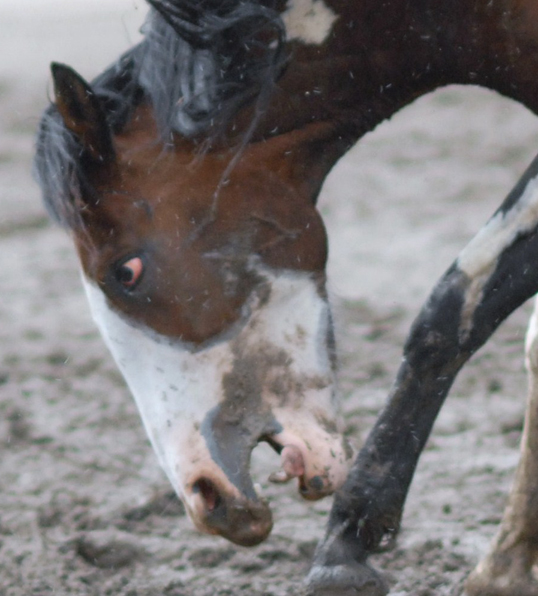
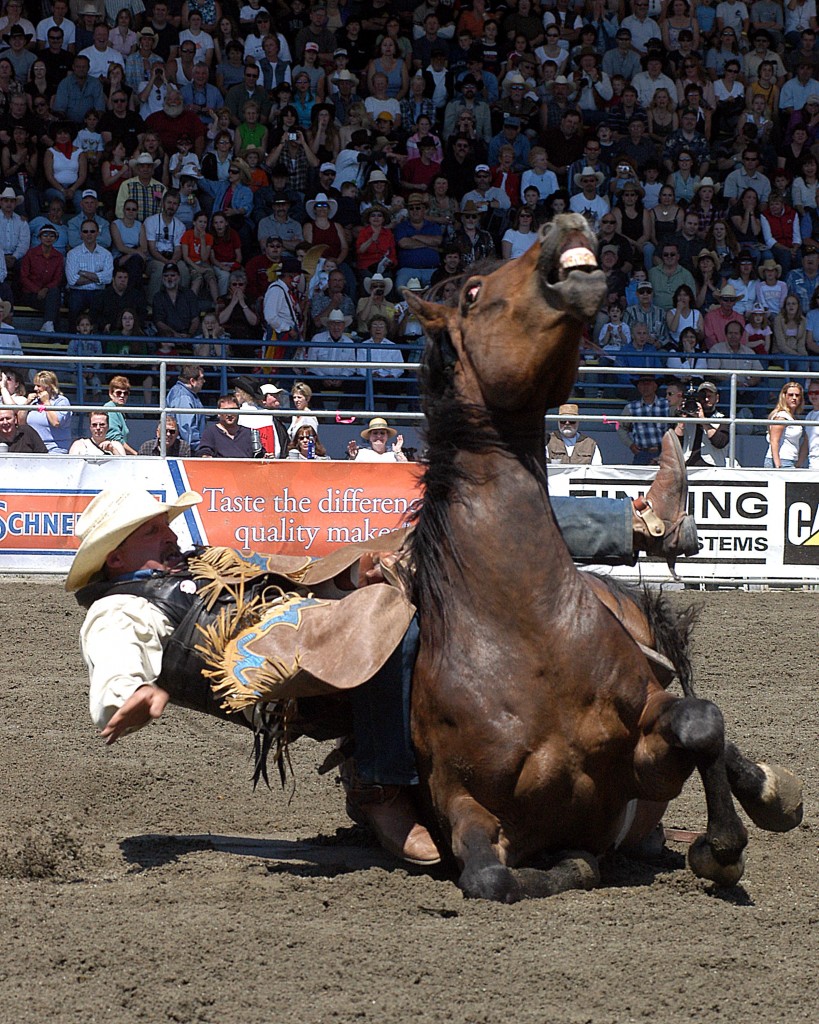
Does this horse look happy?

DSC_0073cr

The photo above is of a bucking horse at the Calgary Stampede. Look closely at the horse’s face in the photo below. 

JMDSC_0073crsmall

Can anyone honestly say they think the horse is enjoying the experience?

Rodeo promoters say that horses in the bareback and saddle-bronc events love to buck, that it’s natural, that the horses are “born to buck.”  It’s true that they are bred for a genetic predisposition to buck – an entire industry has been established to churn out horses that buck.  Yet it is still necessary to tighten a cinch strap around the horse’s flank area. If this kind of bucking is so natural to horses, why are special breeding programs and cinch straps necessary? 

Recently, a bucking horse died at an Alberta rodeo.  The rider described the horse as a “mean sucker.”  Who made him a mean sucker? Breeders and rodeo riders, that’s who.

And when horses still refuse to buck, watch what happens.

And when bucking horses are not good enough for the rodeo, this is what happens.

Why would real cowboys breed horses that are almost impossible to ride?  They wouldn’t be much use on a real ranch would they?  They are only useful for “entertainment” in the cruel circus called rodeo.


Photos: Jo-Anne McArthur


Categories
animal welfare Nesting News/Blog Seagulls

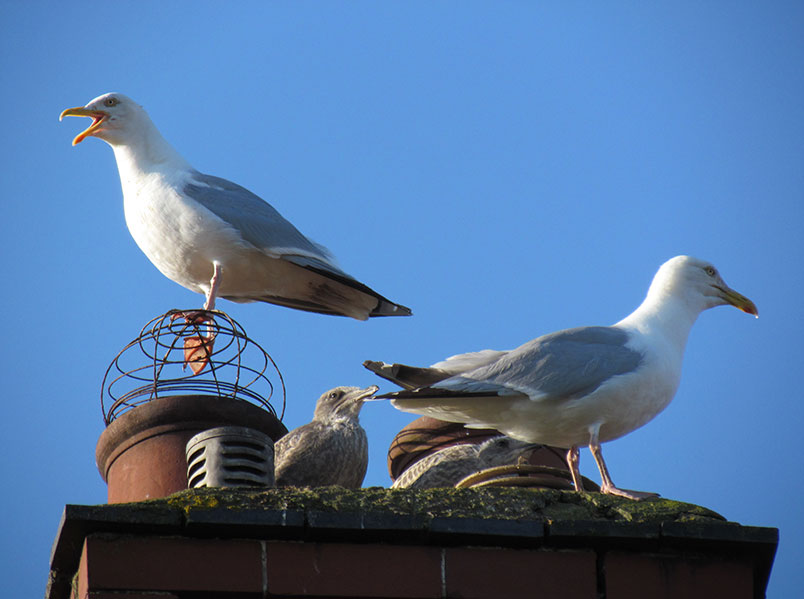
DO NOT DISTURB, I’m nesting!

seagulls nesting

At least that’s what seagulls would tell you if you disturb them right now while they are nesting and hatching their chicks.

This morning, I looked out my window and, on the building next door, I witnessed a maintenance crew disturbing a seagull’s nest with their hoses and safety lines. The gull was frightened and left her nest to circle above, exposing her 3 eggs to the unseasonably cold temperatures.

I went to speak to the crew, taking them a copy of Canada’s Migratory Birds Convention Act, but my comments and handout were mostly disregarded.  After about 7 phone calls and emails to various wildlife authorities and to the property management company, the workers finally ceased operations. However, this took over an hour, and without the mother’s body heat to keep her eggs warm, I do not know whether the eggs will hatch next month. Time will tell.

I found out that it is a federal offense to disturb a seagull’s nest, or the nest of any migratory bird.  Fines are typically $200 and up, and in some cases as high as $10k.

If you witness a nest disturbance, video or photograph the event and people in question, and contact an Environment Canada Wildlife Officer. In Vancouver, the phone number is 604-314-4789, or email is enviroinfo@ec.gc.ca. That’s what I did this morning, albeit after many calls, emails and google searches to find out who had jurisdiction over the matter. Be persistent!

The important thing to remember is that such conflicts can be avoided. From May to August, seagulls flock to high-rise rooftops to build a nest with their mate and lay their eggs. Unfortunately, this coincides with the same time of year when property managers hire window and power washers to clean their buildings’ exteriors. Alas the conflicts with wildlife begin.

Instead, encourage your Strata Council to plan maintenance activities for times of the year when birds are not nesting – fall, winter and early spring – although property managers should be aware of this already. If you MUST access the rooftop, then give the birds and their nest a wide berth so they remain undisturbed, for their welfare and for your own safety.

Seagulls will return to the same nest site from the previous year, so to prevent a nest next year, remove the old one in January or February before it becomes active. If an active nest MUST be removed, for public or bird safety reasons, call a Wildlife Officer to perform the task as they are the only authorities licensed to do so.

For More information about Environment Canada’s Migratory Birds Convention Act visit http://www.ec.gc.ca/nature/default.asp?lang=En&n=496E2702-1 , and for national contact info, visit http://ec.gc.ca/default.asp?lang=En&n=DA294545-1

Leanne McConnachie
Director, Vancouver Humane Society

Categories
animal welfare Dairy News/Blog

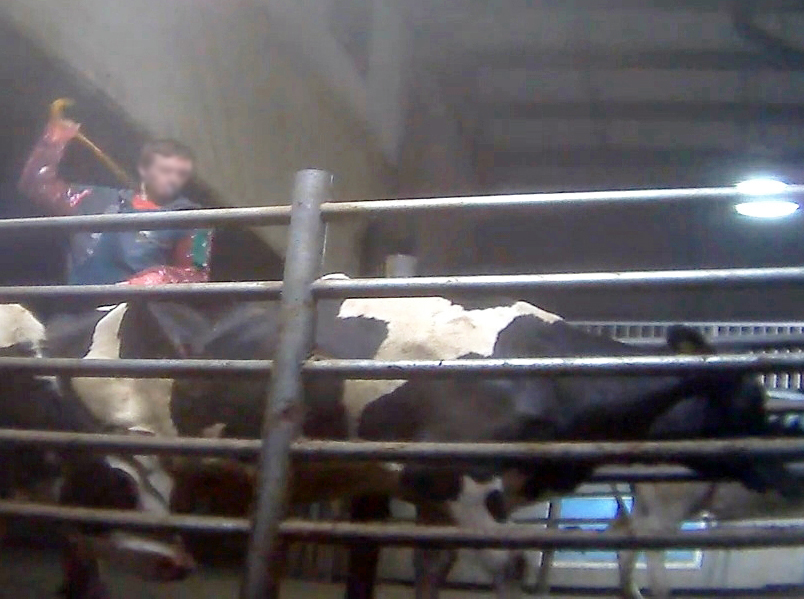
Dairy farm cruelty – What YOU can do

Worker about to beat cowNR

Many people have contacted VHS about the terrible animal cruelty exposed at Chilliwack Cattle Sales, Canada’s largest dairy farm. VHS has published an opinion editorial in the Vancouver Sun, giving our reaction to this horrific example of factory farm mistreatment.

People everywhere are appalled at the unconcionable brutality inflicted on the animals and want to know what to do to help prevent such abuse.  Here are some key actions you can take:

Use social media to get this footage and our op-ed in front of anyone and everyone.

Stop buying dairy products. Animals suffer horribly by the millions in food production in Canada and it’s because consumers demand cheap food. There are now many alternatives to dairy products on the market. If you are not prepared to replace dairy products in your diet, reduce your consumption and purchase certified organic products. That designation means there is some third-party oversight of the farm with the result that the animals have a better quality of life.

Contact Dairyland (Saputo), which buys milk from B.C. dairy farms, including Chilliwack Cattle Sales. They have the ability to demand wholesale changes in animal welfare but they won’t do it if people continue to buy their products.

Contact Canada’s agriculture minister and B.C.’s agriculture minister. The Codes of Practice for farm animal welfare in Canada need to be mandatory and enforceable, with third-party inspections and on-site video surveillance.

Write or email grocery stores to let them know how much your trust in them has been compromised. Ask for concrete assurances with proof that this can never happen again and make it clear that you will not purchase their products until this is done.

Shop at stores with a conscience, like Whole Foods. The Overwaitea Food Group here in B.C. just instituted signage designed by VHS that for the first time in North America, indicates which eggs are from hens kept in cruel wire cages. Please encourage your local grocery stores to do the same.


Categories
animal welfare cruelty News/Blog rodeo

Thank you to everyone who fought against cruelty at the Luxton rodeo

VHS - Victoria Times Colonist Ad -jpegcrop

The campaign against animal cruelty at the Luxton rodeo in Langford, B.C. has gained an unstoppable momentum thanks to the support of compassionate citizens

.


Many people on Vancouver Island and across B.C. supported the campaign against cruel rodeo events in Langford, near Victoria.  VHS would like to thank everyone who supported this effort.

VHS partnered with Victoria Citizens Against Rodeo Events (VCARE) and had the support of the BC SPCA, ensuring a strong message was sent to the rodeo, its sponsors, the public and Langford City Council.  We also gained some celebrity support from Island native Pamela Anderson, who tweeted her opposition to rodeo cruelty.

VHS - Victoria Times Colonist Ad - small
VHS’s full-page ad in the Times-Colonist

We reached many thousands of people with our message, using news media, social media and advertising (including a powerful full-page VHS ad in the Victoria Times-Colonist). VCARE campaigned hard locally and organized protests during the rodeo, attracting more media attention and getting further support.

Many hundreds of people sent emails and letters, signed petitions, attended demonstrations and used social media to voice their concerns for rodeo animals.

As a result, ten local businesses dropped their sponsorship of the rodeo and Langford City Council finally agreed to hear a presentation from VCARE organizer (and nearby Colwood resident) Melissa de Meulles, which called on the council to enact a bylaw banning cruel rodeo events.

The message has been heard and it is only a matter of time before compassion triumphs over cruelty.

VHS plans to keep campaigning on this issue.  We hope we can count on your support as we continue to fight for rodeo animals, who are subjected to pain, fear and stress for the sake of entertainment.

Again, thank you to all the compassionate people who helped us speak on behalf of these vulnerable animals.

Categories
News/Blog Uncategorized

Yes, rodeos ARE cruel

Despite what rodeo promoters say, the evidence is clear that the animals suffer

.


VHS-Family-Pictures-2014-1B

Early on, the controversy over the Luxton Pro Rodeo in Langford, B.C. revolved around Pamela Anderson’s Twitter intervention, dubious allegations about harassment of rodeo sponsors and how the upkeep of the Luxton Fairgrounds can best be funded. Finally, the media focus is now on the animals.

The central question is, or should be, do rodeo animals suffer or don’t they? Rodeo organizers generally avoid the question by referring to the importance of our Western heritage, or by repeating stock phrases like: “We treat these animals like family.”

Unless cowboys routinely chase, rope, pick up and slam their aunts or grandmothers to the ground, it’s hard to see the treatment of rodeo animals as comparable to familial relationships.

Another standard defence is that rodeo is a sport and the animals are athletes that want to compete. But unlike human athletes the animals have no choice in the matter.

calf face largeDoes anyone really believe that an animal would choose to be goaded into an arena to be roped and tied or wrestled to the ground in front of a baying crowd? Are horses and bulls bucking because being spurred by an unwanted rider on their backs and having a cinch strap tightened around their flanks feels good?

It is self-evident that a three-month-old calf being chased across an arena, roped to a jarring halt and thrown to the ground will feel fear, stress and pain. Common sense should make this obvious, but expert opinion also supports the contention.

Dr. Bernard Rollin, a professor of animal sciences at Colorado State University, has written: “Even ranchers are uncomfortable with such an event because the immature animal surely experiences fear and physical pain when jerked at the end of a rope.” (There is a big difference between calf-roping as genuine ranch practice and the sensationalized, high-pressure rodeo event. No one ever timed a real cowboy’s work with a stop-watch and handed out huge sums of money for being the fastest.)

The renowned animal behaviourist, Temple Grandin, who has led the scientific research into the effect of fear on livestock has stated: “The single worst thing you can do to an animal emotionally is to make it feel afraid. Fear is so bad for animals I think it’s worse than pain.” If she’s right, imagine the torment experienced by calves and other rodeo animals.

Perhaps the easiest way to judge whether rodeo is cruel is to look at the ample photographic and video evidence available online. Animal welfare groups, especially in the United States, have recorded numerous animal injuries and deaths at rodeos but just looking at the terrified faces of calves, steers and horses should convince anyone that they are suffering.


One tell-tale sign, if confirmation were needed, is the whitescalf ropingcrop of animals’ eyes often showing in close-up photos. Grandin has written: “When eye white is visible, the animal is agitated and frightened. Two scientific studies have verified the correlation between visible eye white and fear.”
It is worth remembering that all this fear, stress, pain – and sometimes injury and death – is for the sake of entertainment. This is not cattle ranching. No food is produced. Rodeo is just a cruel circus using farm animals.

Some will still say that this is all propaganda by animal rights activists or overly-sentimental animal lovers. If so, then why are virtually all mainstream animal welfare organizations in the developed world opposed to rodeo? This includes our own BC SPCA, the Canadian Federation of Humane Societies, the Humane Society of Canada and the national SPCAs of the United States, Australia, New Zealand and the United Kingdom.

These are the agencies we entrust with the prevention of cruelty to animals and they have determined that many rodeo events are cruel.

So, do rodeo animals suffer? Yes they do. And the only remaining question is why do we allow their suffering to continue? Or, more pertinently, why does a sophisticated and civilized city like Victoria allow this to happen on its doorstep at the Luxton Pro Rodeo in Langford?

Take action against animal cruelty at the Luxton rodeo.

Categories
animal welfare cruelty News/Blog rodeo

VHS ad targets cruelty at Luxton rodeo

VHS - Victoria Times Colonist Ad - small

This is the ad VHS ran in the Victoria Times-Colonist newspaper as part of our campaign against animal cruelty at the Luxton rodeo in Langford B.C., near Victoria.

Please take action to support our campaign.

.

Categories
animal welfare News/Blog

Celebrities and animal welfare

vhs04

.


By Peter Fricker, VHS projects and communications director. This article was originally published online in the Georgia Straight on February 6, 2013.

.


Animal lovers around the world have applauded the many music industry artists who have cancelled appearances at SeaWorld after the documentary Blackfish exposed the inhumane captivity of orca whales at the Florida marine park.

Acts like the Barenaked Ladies (who led the way by cancelling first) have received high praise for taking a principled stand on animal welfare. Those that followed have received considerable positive publicity for their apparent high ethical standards.

One of those acts, the veteran rock band Heart, recently explained their compassion for animals in an interview with Rolling Stone Magazine, in which the band’s Nancy Wilson states: “…when you look at the underbelly of rodeos and carnivals, these animals are tortured and neglected and forced to do things that are highly unnatural for their breeds for our entertainment. It’s really not fair.”

It would be an inspiring expression of compassion if it weren’t for the fact that Heart is booked to appear at one of the biggest rodeos in North America, the San Antonio Stock Show & Rodeo, in February.

Nancy Wilson apparently believes animals are “tortured” at rodeos yet she is going to be part of the entertainment featured at one. But she won’t appear at SeaWorld because of concerns about the orca whales.

The reason for Ms. Wilson’s inconsistent application of principle is unknown. Is it because orca whales have more charisma than calves and steers? Or is it because there hasn’t been a Blackfish-style, blockbuster documentary putting the spotlight on rodeo cruelty?  If there were, would we see artists from the music industry rushing to cancel rodeo appearances?

Could the shocking truth be that celebrities’ business decisions are driven by profit, not principles?

Which brings us to the recent announcement by Canadian icon Shania Twain that she will appear at this year’s Calgary Stampede.

Ms. Twain is a vegetarian (reportedly for ethical reasons) and a well-known animal lover, with a passion for horses. Last December, she promoted her Las Vegas show with a video titled “The Love of Horses” in which she describes the “confidence and trust” that can exist between horses and humans.

That same month, she appeared at the National Finals Rodeo (NFR), riding a horse into the rodeo arena. Videos released by a U.S. animal rights group have shown horses at the NFR being subjected to electric shocks on several occasions, including the December during which Ms. Twain was appearing at the rodeo.

The use of electric shocks is in addition to the routine use of flank straps (tied around the horse’s hindquarters) and spurs that are used to make the horses buck.

The Calgary Stampede, where Ms. Twain is scheduled to appear in July, is noted for its controversial chuckwagon race, in which more than 50 horses have died since 1986.  In 2012, it emerged that the Stampede sends young, unwanted bucking horses to slaughter. Videos have also been released online showing horses at the Stampede being rammed with rods, slapped and goaded to make them perform.

Stampede events like calf-roping and steer-wrestling have also attracted criticism.  Three-month-old calves are routinely chased, roped to a sudden halt and thrown to the ground. Last year, a steer had its neck broken and had to be euthanized.

Mainstream animal welfare groups, including the Canadian Federation of Humane Societies and the national SPCAs of the United States, Australia, New Zealand and the United Kingdom are opposed to rodeo because they have determined that it is inhumane. Even the Calgary Humane Society says it “fundamentally opposes high risk rodeo events like chuckwagon racing, calf-roping, and steer wrestling.”

Apparently, none of this has convinced Ms. Twain that rodeo might be at odds with her own values, ethics and professed love of animals. An online petition has been launched in an attempt to change her mind.

Perhaps it is too much to expect that celebrities should set moral examples.  They are, after all, just entertainers.  But it would be nice if, when they espouse a set of values, they lived by them.


Categories
animal welfare cruelty News/Blog rodeo

Does Heart have a heart for rodeo animals?

calf ropingcrop

Animal advocates in North America and around the world have been thrilled with the decision by a number of music industry artists to cancel concerts at SeaWorld, the controversial marine park in Florida.

The cancellations were sparked by the stunning impact of the film Blackfish, which exposed the suffering of captive Orca whales at marine parks.  Online petitions and social media postings targeted the acts who had signed on to play at the park.

One act that announced it would not appear at SeaWorld is the veteran rock band Heart. The decision, which came amidst online pressure from fans, was announced in a tweet stating that: “Heart has chosen to decline their forthcoming performance at SeaWorld on 2/9/14 due to the controversial documentary film ‘Black Fish’.”

However, Heart is currently set to appear at the San Antonio Rodeo, which, like all rodeos, will feature the inhumane treatment of animals for entertainment.  Can anyone spot the double standard?

It’s great if people in the entertainment industry are going to start including animal welfare concerns in decisions about where they will and will not perform.  But it would be nice if they were consistent.

Perhaps Heart fans who care about animals will make their feelings known to the band.

.

.


Categories
animal welfare compassion fundraising News/Blog

The animals need you

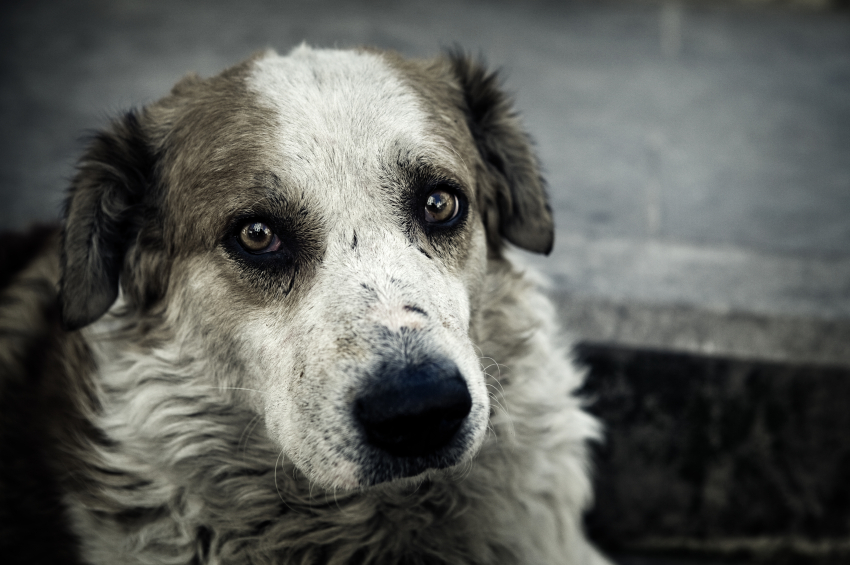
Dogs and other animals need our help

It’s the end of the year.  We hope all our supporters and animal lovers everywhere are having a great holiday season.

We’re looking forward to helping all the animals who, sadly, are not having such a great time.  We’re going to help the sick and injured ones and we’re going to speak out on behalf of those subjected to cruelty and abuse.

Whether it’s animals suffering on factory farms or in rodeos or in zoos, we’ll be there fighting for them.

We hope that today, this last day of 2013, you’ll help make the New Year a better one for animals by supporting VHS’s work.

If you can afford to help, please donate now.  You’ll make a big difference to the lives of animals. Remember, the animals need us.  Without compassionate, caring people to protect their interests they would risk greater neglect, suffering and abuse. We hope you are one of those people.

From everyone at VHS, thank you and Happy New Year to you all.

.

HiRes.


Categories
animal welfare cruelty News/Blog rodeo

If you hate this…

rodeo cruelty

… help us fight it.

.


The Vancouver Humane Society will be carrying its campaign against rodeo cruelty into 2014.  If you’re opposed to abusing animals for the sake of entertainment, we hope you’ll support us.  

Thank you to everyone who helped with our 2013 campaign.

.

.   VHS-login-logo   .