Categories
Food and Drink News/Blog plant-based diet Promoted Recipes Uncategorized vegan vegetarianism

Earth Day: Go plant-based for the planet

Today marks the 48th annual Earth Day celebration and around the world events and efforts will be taking place to draw attention to the need for stronger environmental protections.

As the global community reflects today on the increasingly sensitive state of the planet and what role we as individuals can play in tackling what can sometimes feel like an overwhelming issue, it’s important to remember that every time we sit down to eat, we have an opportunity to stand up for a better world.

Animal agriculture has been identified as a leading contributor not only to climate change, but to air and water pollution, water use, land degradation, deforestation and biodiversity decline.

In fact, animal agriculture is responsible for more greenhouse gas emissions than the entire global transportation sector. This is because animal-based foods are incredibly inefficient to produce and are very resource-intensive. The processes involved when it comes to raising, transporting and slaughtering animals for food are responsible for potent greenhouse gas emissions including carbon dioxide, methane and nitrous oxide. To put this in perspective, beef production requires 20 times more land and emits 20 times more greenhouse gas emissions per unit of edible protein than common plant-based protein sources such as beans, peas and lentils.[1]

The production of animal-based foods also requires and pollutes large amounts of water. Agriculture accounts for 92% of our global freshwater footprint; approximately one third relates to animal products.[2] The water footprint per gram of protein for milk, eggs and chicken is approximately 1.5 times larger than for pulses (beans, lentils, peas). For beef, it is six times larger than for pulses.[3] The sheer volume of animal waste, along with fertilizers and pesticides used for feed crops, as well as hormones and antibiotics used on livestock create major water pollution issues. These pollutants seep into waterways, threatening water quality, ecosystems and animal and human health.[4]

Meanwhile, animal agriculture is a key contributor to land degradation and deforestation, with one-quarter of the earth’s land surface (excluding Antarctica) being used as pastureland. [5] The conversion of natural habitat to accommodate livestock and feed crops puts immense pressure on wildlife that struggle to survive in increasingly fragmented and degraded environments. Ineffective and ill-informed cull programs put additional pressure on predator populations, due to the perceived threat they pose to livestock profits.

While our diet can be a major part of the problem when it comes to protecting the planet, that also means it is a crucial part of the solution. A 2016 Oxford Martin School study found that the adoption of global dietary guidelines would cut food-related emissions by 29%, vegetarian diets by 63%, and vegan diets by 70%.[6] By reducing and eliminating resource-intensive animal products from our diet and supporting efforts to make more sustainable plant-based foods widely accessible, we can drastically decrease our individual and societal environmental footprints.

This Earth Day, join the growing number of people around the world who are recognizing the power behind what we put on our plate. Take our Meatless Monday pledge for recipe ideas and download our Live Well booklet to learn more about a plant-based diet. You can also support VHS’s efforts to introduce more healthy, humane and sustainable plant-based menu options in schools and other institutions.

[1] http://www.wri.org/blog/2016/04/sustainable-diets-what-you-need-know-12-charts

[2] http://waterfootprint.org/media/downloads/Gerbens-et-al-2013-waterfootprint-poultry-pork-beef_1.pdf

[3] http://waterfootprint.org/en/water-footprint/product-water-footprint/water-footprint-crop-and-animal-products/

[4] http://www.fao.org/3/a-i7754e.pdf

[5] http://www.wri.org/blog/2016/04/sustainable-diets-what-you-need-know-12-charts

[6] https://www.oxfordmartin.ox.ac.uk/news/201603_Plant_based_diets

Categories
animal welfare compassion Cruelty-free Dairy Food and Drink News/Blog plant-based diet Promoted school Uncategorized vegan vegetarianism

Meatless Monday is on the menu at Kwantlen Polytechnic

Kwantlen Polytechnic University’s food service provider, Sodexo, and the school’s “Let’s Be Compassionate” club recently joined forces to raise awareness of the University’s involvement in the increasingly popular Meatless Monday movement.

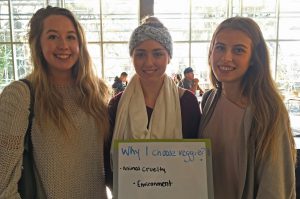
The two groups organized a Meatless Monday outreach event at the Surrey campus, where they distributed information about the benefits of a plant-based diet and samples of the cafeteria’s Meatless Monday options. Students who stopped by the table were able to sample wraps, chili, 3-bean soup and hummus with pita chips and learn about how a plant-based diet helps tackle factory farming and climate change, while also protecting against preventable health conditions like heart disease, stroke, cancer, and diabetes.

“Being able to educate and share information about veganism, plant-based eating and animal welfare with the students at Kwantlen has been a really positive experience so far,” said club member, Sasha. “One of the greatest parts of promoting a plant-based diet is the satisfied and surprised look on people’s faces when they try the samples. We’re helping show them that meals without meat can taste even better and that eliminating meat from their diet one day a week can easily turn into seven days a week!”

A recent survey by Dalhousie University revealed similar enthusiasm for meat reduction, with nearly 40% of British Columbians 35 and under indicating they follow a vegetarian or vegan diet. The national survey also suggested that British Columbia is leading the way when it comes to eating meatless.

“Skipping meat one day a week is good for you and better for the planet,” said Sodexo Marketing Coordinator, Colleen Dang-Wong. “Together with the Let’s Be Compassionate Club, we can educate our campus community on the benefits of plant-based eating and what we offer on campus to support this global initiative.”

Kwantlen joins 16 other Metro Vancouver secondary and post-secondary schools that are participating in Meatless Monday. In addition to the items sampled during the outreach event, other meatless menu options include a veggie burger (which can be made vegan), as well as grab and go vegan salad options.

Follow Kwantlen’s lead by pledging to go meatless on Mondays and we’ll send you a weekly recipe to help you along! Check out meatlessmonday.ca to learn more and to support our effort to bring the initiative to more classrooms, cafeterias and communities. Interested in bringing Meatless Monday to your school, workplace or community? Get in touch with Program Coordinator, Emily Pickett, to learn more.

Categories
News/Blog Uncategorized

This is a happy ending that will warm your heart!

Ozzie recovering at home

Ozzie is a sweet young ginger boy who stole Trasi’s heart when she met him at a shelter. She adopted him on the spot and couldn’t wait to get him home!

The two-year-old cat loved his new home. After a few months, Trasi decided to let him enjoy the outdoors by taking him out on a harness. One day while out for a stroll, he was startled by a loud noise – causing him to suddenly back out of the harness and disappear!

Trasi was devastated. She did everything she could – checked shelters, put up posters, put lost notices on every single website she could think of. Finally, after he’d been missing for a month, she started getting calls from people in the neighbourhood who thought they had seen him. She knew she’d have to set a humane trap, so she called VHS.

VHS lent her a trap, but more importantly, we contacted our cat expert, June, a former VHS director who still manages our emergency veterinary care fund (the McVitie Fund). I have known June for over twenty years, and I don’t know anyone who has a store of knowledge about such things as her.

Trasi diligently followed June’s advice by setting the trap, monitoring it from a short distance whenever it was set, and being prepared to release any other creature that may inadvertently be caught. She soon realized that the sightings had been a neighbourhood ginger cat and Ozzie was nowhere in the area. She was heartbroken, and reluctantly decided to abandon her vigil.

Then her luck changed!  She received a call from someone in Marpole who had found a ginger cat whose microchip traced back to Trasi’s contact information!!! Ozzie had wandered into someone’s back yard weak and starving, and desperate for food, had followed his rescuer right into the house.

Trasi was overjoyed! Ozzie had lost 60% of his body weight and was famished, and his claws were worn down to nubs, indicating he had been trapped somewhere at some point.  But otherwise he seemed unharmed. She immediately took him to the vet, where he underwent a thorough exam, including blood work. He’s anemic and will need follow-up testing, but day by day he is gradually resuming his previous mischievous behaviour!

Although VHS’s trap didn’t prove successful in helping Ozzie get back to his home, his guardian cited June with keeping her positive with support and encouragement through the entire process. Ozzie had wandered from Kerrisdale all the way to 68th Ave. in Marpole, a truly incredible distance.

Needless to say, the microchip was key in reuniting Trasi and Ozzie. Cats and dogs should always have this form of ID! VHS also recommends a collar and tag with, most importantly, a phone number, as well as a clear ear tattoo, as close as possible to the top of the ear. This increases the chances three-fold that a lost companion animal can be reunited with their guardian. As well, people should be aware that harnesses are not escape-proof. We (and Trasi) think that they’re risky and there are safer ways to enrich a cat’s environment.

This has been a wonderful Christmas for Ozzie and Trasi. They ask that in honour of Ozzie, VHS donors support the McVitie Fund for needy animals. Right now, your donation will be doubled by a generous anonymous supporter who has issued a $20,000 challenge!! We have already reached nearly $15,000 – only another $5,000 to go and the amount will be doubled to $40,000! Ozzie doesn’t need it, but many other animals do – we’ve already had three calls for help this week, including one about a beautiful nine-year-old dog who was hit by a car. Please help us if you can!!

Categories
animal welfare compassion cruelty Food and Drink News/Blog plant-based diet Promoted Uncategorized vegan vegetarianism

Helping animals on Giving Tuesday

Garth is one of the newest (and youngest!) animals at The Happy Herd Farm Sancturary. He’s someone, not something. That’s why VHS promotes a plant-based diet and cruelty-free living.


Making life better for animals now and in the future

On November 28, the Vancouver Humane Society (VHS) and The Happy Herd partnered for Giving Tuesday to raise $10,000 to help rescued farmed animals and to fight factory farming by promoting cruelty-free living. 

Thank you to everyone who donated toward our campaign, to our generous matching gift sponsors, Lisa Kramer and Mark Kamstra, and for each of the partner businesses who supported us by raising funds for this campaign. Be sure to check out our complete list of Giving Tuesday partners and show your support for these compassionate businesses that give back to our community!

At The Happy Herd Farm Sanctuary in Aldergrove, B.C., animals are treated with compassion, not as the exploitable commodities we see on industrialized farms.  When animals are seen as valued, sentient beings it’s clear each one is  “someone, not something.” So shouldn’t we treat them accordingly?

That’s the question that underpins VHS’s campaigns for cruelty-free living. VHS volunteers are out on the streets and at events distributing our Go Veg booklet to thousands of people who want to live more compassionately.  More people are joining our Go Veg Campaign and our Meatless Monday program every day and we’re helping schools, hospitals and businesses increase their offering of humane, sustainable and healthy plant-based dishes. Every year our bus ads prod the consciences of Vancouverites, asking why we treat some animals as friends and others as food.  Together we are changing hearts and minds. Thank you for your support!


Categories
animal welfare News/Blog Promoted Uncategorized wildlife

Call for a complete ban on BC’s grizzly bear hunt

Have your say on trophy hunting of B.C.’s grizzly bears

On August 14, 2017, the B.C. government announced that effective Nov. 30, 2017, it will end the trophy hunting of grizzly bears province-wide and stop all hunting of grizzly bears in the Great Bear Rainforest.

While VHS welcomes the effort to end B.C.’s notorious trophy hunt, we have serious concerns about a proposed regulation that would allow grizzlies to be hunted for meat throughout the rest of the province. This would create a loophole that would allow the trophy hunt to continue under the guise of a meat hunt.  

Grizzlies are considered a vulnerable species and a new report from B.C.’s auditor general found that the provincial government has not fulfilled long-standing commitments for managing grizzly bears. This report underscores the importance that now, more than ever, we need to end the grizzly bear hunt in its entirety if we want to help alleviate the pressures facing this keystone species. 

The province is seeking feedback from the public regarding the proposed grizzly bear hunting regulations. Comments can be sent to grizzly.bear@gov.bc.ca and the deadline is Nov. 2, 2017.

VHS is calling for a complete ban on all grizzly hunting across the province, as outlined in our submission to the Fish and Wildlife Branch. Please feel free to use our submission to guide your own.

Categories
animal welfare compassion Cruelty-free Food and Drink News/Blog plant-based diet Promoted school Uncategorized vegan vegetarianism

Meatless Monday is on the move

Meatless Monday at Langara College.

Mark May 15th in your calendars! In an effort to raise awareness of the links between diet, the environment, health and animal welfare, Vancouver Mayor Gregor Robertson has proclaimed Monday May 15th, 2017 to be Meatless Monday.

The globally popular movement, aimed at increasing awareness about the impact of our food choices and improving access to humane, healthy and sustainable food options, has been gaining popularity in Metro Vancouver. To date, ten schools have embraced the “once a week, cut the meat” message, with the most recent being Sutherland Secondary in North Vancouver. Sutherland launched their cafeteria campaign with the leadership of their new Meatless Monday club, comprising students who are passionate about the impact eating meatless has on pressing issues like factory farming, climate change and individual and public health.

Sutherland’s Meatless Monday club got its start after students learned that Capilano University was implementing the meat reduction initiative with support from VHS. Program Coordinator, Emily Pickett, was thrilled to help Sutherland’s Meatless Monday club bring the campaign to their cafeteria. Just a couple of months in and the club has worked closely with food service provider, Amaga Foods, to add and promote delicious menu items like Mexican bean burritos, Mediterranean chickpea salad, tofu fried rice and lentil vegetable curry with rice.

Sutherland Secondary launches Meatless Monday

“Our club does regular outreach in our school’s cafeteria to help raise awareness of Meatless Monday, the benefits of participating and what meatless options are on the menu, “ says club organizers Naiara Peruchena and Shiqi Xu. “We are thrilled to see sales of the meatless Monday special steadily increase and we think this initiative is important for helping students become more aware of what’s on their plate and the impact that has beyond their plate.”

But it’s not just schools who are getting on board, Cabrito, a Spanish tapas restaurant on Vancouver’s Commercial Drive, also recently embraced Meatless Monday. Jamie Stolar, Cabrito’s general manager, says the idea emerged from a mix of reasons. “We love the idea of being able to encourage people that aren’t vegan or vegetarian that even choosing one day a week to eat meet free can make a difference.”

Cabrito’s Meatless Monday offer includes a sampler of the three items for $19, allowing diners to try a few different items for a great value and still leave full. Currently, both vegetarian and vegan options are available, but Stolar say the focus will be “100 per cent vegan going forward.”

Cabrito’s Roasted vegetable sliders

Stolar thinks Meatless Monday has lots of potential, given Vancouver’s veg-friendly nature. “It would be really cool to see more restaurants join the movement as it’s such a great way to educate people and get them to start thinking about what they are consuming. It leaves them with ideas that they can incorporate into their daily lives.”

The Mayor’s May 15th Meatless Monday proclamation is not only a great show of support for the local schools, businesses and individuals who have already embraced Meatless Monday, but it may be just the type of encouragement needed to take Meatless Monday to the next level!

VHS has invited other Lower Mainland municipalities to follow Vancouver’s lead and pass similar proclamations in solidarity and is encouraging citizens, schools, businesses and the community as a whole to embrace plant-based eating on Monday, May 15th (and every Monday moving forward)! Get in touch with Program Coordinator, Emily Pickett, to learn more and get involved.

Categories
animal welfare compassion Cruelty-free Food and Drink News/Blog plant-based diet Promoted school Uncategorized vegan vegetarianism

Meatless Monday on the menu at Simon Fraser University

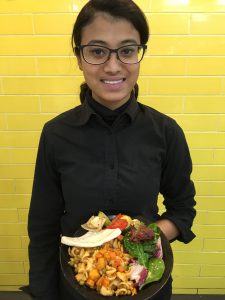
Stop by the residence dining hall at Simon Fraser University’s (SFU) Burnaby campus on Mondays and you’ll notice a variety of veg options being promoted. Food service provider, Chartwells, has been offering up delicious dishes including veg burgers, pizza, pasta, curries, salads and soups as part of their Meatless Monday initiative.

“Meatless Mondays is a simple concept that everyone can support. There are so many great veg options available these days that choosing to go meat-free, even one day a week, has never been easier! There are also a number of benefits, not just for the environment or animal welfare, but for a person’s health and general well-being too,” said Shehani Perera, Manager & Executive Chef at the residence dining hall.

Perera says feedback surrounding the initiative has been positive, with a growing number of students open to the concept of eating in a more humane, healthy and sustainable way. Student groups are also promoting the many benefits of cutting back on meat. Embark, a non-profit student society focused on sustainability, is supporting the Dining Services’ initiative via their “Monday Veggie Challenge”.

“Embark recognizes the destructive impact the meat industry has both on the planet and on human health,” explained Ali White, Programs Manager of Embark. “We’re asking the SFU community to choose plant-based options just one day a week! Participants can post their photos of vegetarian meals using the hashtag #SFUVeggieChallenge to enter to win a prize every month.”

It’s not just the sustainability crowd getting on board either; SFU’s Health Peers Program is also helping spread the word about the benefits of going meatless on Mondays.

“As students invested in health education efforts at SFU, the Health Peers recognize the value in supporting the Meatless Monday initiative,” said Health Peers member Savannah Swann. “While we promote Meatless Monday when possible through our presence at food-related events and outreach every year, our greatest contribution to this cause is through our bi-weekly Community Cooking Workshops. These workshops teach students about nutrition and help them to develop basic food preparation skills. We intentionally showcase easy vegetarian/vegan meals and always provide vegetarian/vegan options. We are proud to advocate for a cause that supports student health (financially and physically) and contributes to environmental sustainability.”

SFU is joined by seven other Metro Vancouver schools which are being supported by VHS in offering meatless menu options on Mondays.

“We’re thrilled to see schools and students embracing the Meatless Monday concept! Every time we eat meatless, we’re reducing the demand for cheap meat, which sentences over 700 million animals every year to lives of misery and deprivation on factory farms. It’s empowering that we can have a huge impact simply by what we choose to put on our plate,” said VHS Program Coordinator, Emily Pickett.  

Follow SFU’s lead by taking our Meatless Monday pledge today! We’ll send you a weekly recipe to help you keep your commitment. You can also support our effort to bring Meatless Monday to more classrooms, cafeterias and communities by making a donation today. Interested in bringing Meatless Monday to your school, workplace, business or community? Get in touch with Program Coordinator, Emily Pickett, to learn more!

Categories
animal welfare Food and Drink News/Blog plant-based diet Promoted Recipes school Uncategorized vegan vegetarianism

Chartwells & Langara College Lead Lower Mainland Meatless Monday Effort


langara-blog-post3

It’s been over a year and a half since Vancouver’s Langara College became the first campus in Western Canada to join the globally popular Meatless Monday movement. The Vancouver Humane Society (VHS) first introduced the initiative in March 2015 to Langara’s Environmental Club and food service provider, Chartwells. Both groups eagerly supported bringing it to the school’s cafeteria after learning about the impact of our society’s overconsumption of meat on animal welfare, the environment and public health.

“We felt this was a great opportunity to take a small, but powerful, step by raising awareness of the impact of our food choices and offering options to reduce that impact,” said Rizwan Bandali of Chartwells/Compass Group.

And seize that opportunity is exactly what Chartwells and Langara College did, with the introduction of delicious meatless menu items! The cafeteria kicks off each week with a wide variety of options, from roasted veggie paninis and mouth-watering curries to meatless meatballs, veg lasagna and creative tofu dishes.

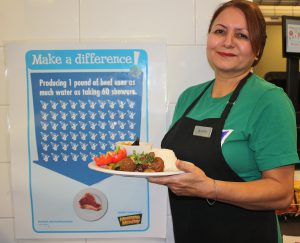
langara-blog-post7Meatless Monday specials have been paired with eye-catching, educational posters aimed at raising awareness and boosting participation in the initiative. Statistics outlining water use and greenhouse gas emissions from meat production are another way the campaign extends education into the cafeteria and inspires individual action.

Chartwells reports sales have been steadily increasing and feedback regarding the meatless items has been very positive. So much so that the cafeteria recently began offering an additional daily hot vegetarian bar, adding even more meatless options to the menu.

Langara’s campaign has effectively blazed a trail for other Lower Mainland schools interested in taking similar steps to help protect animals, our health, and the planet. To date, the British Columbia Institute of Technology, Eric Hamber Secondary and Winston Churchill Secondary have implemented similar initiatives and others are set to join as well.langara-blog-post1

“We’re thrilled to see Meatless Monday catching on here in the Lower Mainland and we commend Chartwells Langara for helping make that possible. Factory farming, climate change and public health are major issues facing us today. They can seem overwhelming from an individual perspective, but when we realize that we can have a significant impact simply by what we choose to put on our plate, we can take steps to support a kinder, cleaner and healthier world,” said VHS Program Coordinator, Emily Pickett.

Follow Chartwells Langara’s lead by taking our online Meatless Monday pledge. We’ll share a weekly recipe to help you keep your commitment! You can also support our effort to bring Meatless Monday to more classrooms, cafeterias and communities by making a donation today. Interested in bringing Meatless Monday to your school, workplace, business or community? Get in touch with Program Coordinator, Emily Pickett, to learn more!

Categories
fundraising News/Blog Promoted Scotiabank Uncategorized

We reached our goal – thanks to you!

team pic 2016

On Sunday, June 26th, Team VHS ran for the animals in the Scotiabank Half-Marathon & 5k. This year marks VHS’s sixth year participating in the Scotiabank Charity Challenge. Thanks to our amazing team of runners and all of the generous donors who sponsored our team, an incredible total of $39,100 was raised to support VHS’s work to help animals.

The Scotiabank Charity Challenge is the most important fundraiser of the year and it enables us to continue our work to protect animals from exploitation and abuse, whether it’s due to factory farming, captivity or entertainment. The funds also allow us to assist low-income guardians in getting their pet spayed/neutered or in emergency situations. Learn more about our campaign work and how you can get involved!

We couldn’t do this important work without you! From the entire VHS Team, thank you to everyone who participated and sponsored our team in the Scotiabank Charity Challenge. A big thank you to West Coast Monograms for the great team t-shirts!

VHS at the Scotiabank Half Marathon and 5K

Vancouver Humane Society at the Scotiabank Half Marathon and 5K!


Categories
animal welfare compassion cruelty News/Blog Promoted Uncategorized

CBS: End the exploitation of wild animals on show “Zoo”

tigerVHS is joining the call for CBS to end the use of wild animals in the filming of its show “Zoo”. The Vancouver-shot series is based on James Patterson’s 2012 novel by the same name and is a thriller about a zoologist’s investigation into a wave of violent animal attacks against humans around the world.

For a series that’s based on the story-line that captive and exploited animals are fighting back against their oppressors, it’s disturbing that CBS itself fails to see the lesson and contributes to such exploitation through their use of wild animals, including bears, wolves and big cats, who have been forced to perform in the series. These animals are denied any semblance of a natural life and are transported around, caged, chained and forced to perform for mere entertainment.

Computer-generated imagery (CGI) has come a long way and has been used in other films to create realistic looking animals without the use and abuse of live ones, a popular example of this being Disney’s “The Jungle Book”.

Please join us in calling on CBS to follow the lead of others in the film industry by ending their use of wild animals and instead utilizing CGI technology in their productions. You can submit your request by visiting CBS’s website and selecting “Zoo” under the category drop-down of the feedback form.